Part 7 of 11 · JLPT N1
秘密 Himitsu, part 7: A Note Slipped Into a Sleeve
In this part
Envy of the woman's beauty turns into desire, and the disguised narrator slips her a note in archaic style asking her to meet him again. As the crowd leaves she whispers that he is 'arrested at last'. At the temple he finds her reply hidden in his hood: she recognised him from the start and agrees to meet, but only if a rickshaw man takes him, blindfolded, to her house.
AI translation · independently checked
私は美貌を羨む嫉妬の情が、胸の中で次第々々に恋慕の情に変って行くのを覚えた。I felt the envy with which I had begrudged her beauty changing, little by little, within my breast into amorous longing.
女としての競争に敗れた私は、今一度男として彼女を征服して勝ち誇ってやりたい。Defeated in the contest as a woman, I now wished to conquer her once more as a man and to exult in my triumph.
こう思うと、抑え難い欲望に駆られてしなやかな女の体を、いきなりむずと鷲掴みにして、揺す振って見たくもなった。At this thought, driven by an irresistible desire, I even felt like suddenly seizing that supple woman's body roughly in my clutches and shaking it.
君は予の誰なるかを知り給うや。Dost thou know who I am?
今夜久しぶりに君を見て、予は再び君を恋し始めたり。Seeing thee tonight after so long, I have begun once more to love thee.
今一度、予と握手し給うお心はなきか。Hast thou no wish to clasp my hand once again?
明晩もこの席に来て、予を待ち給うお心はなきか。Hast thou no wish to come to this seat tomorrow night as well, and wait for me?
予は予の住所を何人にも告げ知らす事を好まねば、唯願わくは明日の今頃、この席に来て予を待ち給え。Since I care not to make my abode known to any person, I ask only this: come to this seat tomorrow at this same hour, and wait for me.
闇に紛れて私は帯の間から半紙と鉛筆を取出し、こんな走り書きをしたものをひそかに女の袂へ投げ込んだ、そうして、又じッと先方の様子を窺っていた。Under cover of the darkness I took paper and pencil from the folds of my obi, dashed off these lines, and slipped them secretly into the woman's sleeve; then I went back to watching her intently to see what she would do.
十一時頃、活動写真の終るまでは女は静かに見物していた。Until the moving pictures ended at about eleven o'clock, the woman sat quietly watching.
観客が総立ちになってどやどやと場外へ崩れ出す混雑の際、女はもう一度、私の耳元で、In the crush, as the audience rose all at once and came pouring noisily out of the hall, the woman once again, close to my ear,
「……… Arrested at last. ………」"……… Arrested at last. ………"
と囁きながら、前よりも自信のある大胆な凝視を、私の顔に暫く注いで、やがて男と一緒に人ごみの中へ隠れてしまった。whispered, and after fixing a bolder, more assured gaze than before on my face for some moments, she presently vanished into the crowd together with the man.
「……… Arrested at last. ………」"……… Arrested at last. ………"
女はいつの間にか自分を見附け出して居たのだ。Without my noticing, the woman had found me out.
こう思って私は竦然とした。At this thought I shuddered.
それにしても明日の晩、素直に来てくれるであろうか。Even so, would she obligingly come tomorrow night?
大分昔よりは年功を経ているらしい相手の力量を測らずに、あのような真似をして、却って弱点を握られはしまいか。Might I not, by playing such a trick without measuring the strength of an adversary who seemed to have gained a good deal of experience since the old days, instead end up letting her get hold of my weak point?
いろいろの不安と疑惧に挟まれながら私は寺へ帰った。Beset by all manner of unease and misgiving, I returned to the temple.
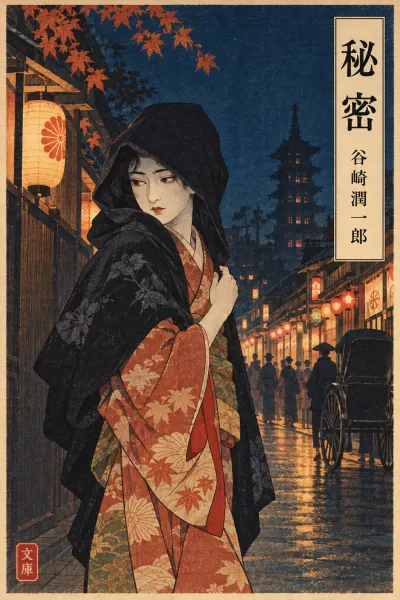
いつものように上着を脱いで、長襦袢一枚になろうとする時、ぱらりと頭巾の裏から四角にたたんだ小さい洋紙の切れが落ちた。As I was taking off my outer kimono as usual, about to strip down to nothing but my long under-kimono, a small scrap of Western paper folded into a square fluttered out from the lining of my hood.
「Mr. S. K.」"Mr. S. K."
と書き続けたインキの痕をすかして見ると、玉甲斐絹のように光っている。When I held the traces of ink from these words up to the light, they shimmered like iridescent Kai silk.
正しく彼女の手であった。It was unmistakably her hand.
見物中、一二度小用に立ったようであったが、早くもその間に、返事をしたためて、人知れず私の襟元へさし込んだものと見える。During the show she had seemed to get up once or twice to relieve herself; it appeared that in that brief time she had already written a reply and slipped it, unseen by anyone, into my collar.
思いがけなき所にて思いがけなき君の姿を見申候。In a place I little expected, I beheld thee in a guise I little expected.
たとい装いを変え給うとも、三年このかた夢寐にも忘れぬ御面影を、いかで見逃し候べき。Though thou change thy attire, how should I fail to know the face I have not forgotten even in my dreams these three years past?
妾は始めより頭巾の女の君なる事を承知仕候。From the very first I knew full well that the hooded woman was thou.
それにつけても相変わらず物好きなる君にておわせしことの可笑しさよ。And withal, how droll that thou shouldst be as fond of strange whims as ever!
妾に会わんと仰せらるるも多分はこの物好きのおん興じにやと心許なく存じ候えども、あまりの嬉しさに兎角の分別も出でず、唯仰せに従い明夜は必ず御待ち申す可く候。I fear that thy wish to meet me is most likely but another sport of this same whim; yet so great is my joy that I can weigh nothing wisely, and shall simply obey thy bidding and without fail await thee tomorrow night.
ただし、妾に少々都合もあり、考えも有之候えば、九時より九時半までの間に雷門までお出で下されまじくや。Only, since I have certain circumstances of mine own, and certain designs besides, wouldst thou not be pleased to come to the Kaminarimon between nine and half past nine?
其処にて当方より差し向けたるお迎いの車夫が、必ず君を見つけ出して拙宅へご案内致す可く候。There a rickshaw man whom I shall send to meet thee will surely find thee and conduct thee to my humble dwelling.
君の御住所を秘し給うと同様に、妾も今の在り家を御知らせ致さぬ所存にて、車上の君に眼隠しをしてお連れ申すよう取りはからわせ候間、右御許し下され度、若しこの一事を御承引下され候わずば、妾は永遠に君を見ることかなわず、これに過ぎたる悲しみは無之候。Even as thou concealest thine abode, so do I purpose not to make known to thee where I now dwell, and I have therefore arranged that thou be blindfolded in the rickshaw and so brought to me; I pray thee pardon this, for if thou wilt not grant this one thing, I shall never be able to see thee, and no sorrow could be greater than that.
私はこの手紙を読んで行くうちに、自分がいつの間にか探偵小説中の人物となり終せて居るのを感じた。As I read on through this letter, I felt that I had somehow become, in every respect, a character in a detective story.
不思議な好奇心と恐怖とが、頭の中で渦を巻いた。A strange curiosity and dread swirled together in my head.
女が自分の性癖を呑み込んで居て、わざとこんな真似をするのかとも思われた。It occurred to me, too, that the woman might have grasped my peculiar tastes and be doing such things on purpose.
Vocabulary
| Word | Meaning | JLPT |
|---|---|---|
| 嫉妬しっと | jealousy, envyBoth kanji contain 女 (woman). | N1 |
| 恋慕れんぼ | amorous longing, loveLiterary; 恋慕の情 means 'feelings of love'. | — |
| 征服せいふく | conquest; to conquer (with する) | N1 |
| 鷲掴みわしづかみ | seizing roughly in one's gripLiterally 'an eagle's grab'; 〜にする = to grab hold of something roughly. | — |
| 袂たもと | the hanging pouch of a kimono sleeveOften used as a pocket for small things. | — |
| 窺ってうかがう | to watch closely, to observe secretlydictionary form: 窺うDifferent kanji from 伺う (to visit / to ask, humble), though both are read うかがう. | — |
| 竦然しょうぜん | shuddering with fearLiterary; 竦然とする = to shudder, to be horrified. | — |
| 年功ねんこう | experience gained over the years年功を経る = to grow seasoned with time. | — |
| 頭巾ずきん | hood, cloth head-coveringPart of the narrator's female disguise. | — |
| 夢寐むび | sleep, dreamsMainly found in the set phrase 夢寐にも忘れない, 'never forget even in one's dreams'. | — |
| 物好きものずき | fondness for odd things; a person with curious whimsOften slightly teasing. | N1 |
| 拙宅せったく | my humble homeHumble word used only for one's own house. | — |
| 眼隠しめかくし | blindfolddictionary form: 目隠しUsually written 目隠し today. | — |
| 性癖せいへき | disposition, peculiar habit or taste | — |
Grammar
〜給う N1 classical honorific auxiliary
Added to a verb stem, 給う raises the action of the person addressed, much like modern お〜になる. The imperative 給え makes a courteous request, as in 待ち給え, 'wait for me'.
君は予の誰なるかを知り給うや。
Dost thou know who I am?
〜ねば N1 since (one) does not…
ね is the realis form (已然形) of the classical negative ず, and ば after the realis gives a reason or cause rather than a hypothetical condition. 好まねば therefore means 'as I do not like', the same as modern 好まないので.
予は予の住所を何人にも告げ知らす事を好まねば
Since I care not to make my abode known to any person
〜はしまいか N1 might it not be that…? (anxious doubt)
まい is a negative conjectural ending, and the question marker か turns it into an anxious question: 'might it not be that…?'. The particle は is inserted after the continuative form of the verb (here the passive 握られ) for emphasis. 握られはしまいか means 'might I not end up having (my weak point) seized?'
却って弱点を握られはしまいか。
might I not instead have let her take hold of my weak point?
〜ものと見える N2 it appears that…
This expresses an inference drawn from visible evidence. Here the narrator reasons back from the note he has found to how she must have planted it.
人知れず私の襟元へさし込んだものと見える。
it appeared that she had slipped it, unseen by anyone, into my collar.
〜候 (sōrōbun) N1 classical polite epistolary ending
候 (そうろう) works like a very formal です/ます in traditional letters. It combines with humble verbs such as 仕る and 申す and with classical forms such as 可く候 ('shall') and 無之候 ('there is not').
妾は始めより頭巾の女の君なる事を承知仕候。
From the very first I knew full well that the hooded woman was thou.
いつの間にか N3 before one knew it; without noticing
This describes something that happened unnoticed. Here it stresses that she found him out while he thought he was safely disguised.
女はいつの間にか自分を見附け出して居たのだ。
Without my noticing, the woman had found me out.