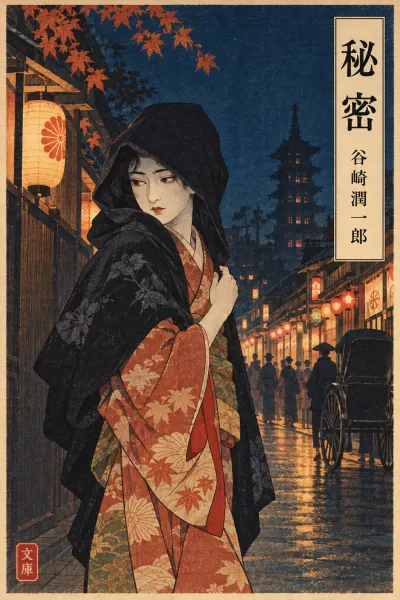
Part 5 of 11 · JLPT N1
秘密 Himitsu, part 5: Nightly Masquerades in Asakusa
In this part
Disguised as a woman, the narrator finds that the familiar night life of Asakusa Park looks new and dreamlike. He goes out in costume every night, sometimes carrying a dagger or a narcotic so that he can feel the romance of crime without committing one. About a week later, sitting drunk in the special guests' seats upstairs at a cinema, he notices that a beautiful, striking woman and her gentleman companion have sat down beside him.
AI translation · independently checked
いつも見馴れて居る公園の夜の騒擾も、「秘密」を持って居る私の眼には、凡べてが新しかった。Even the nightly tumult of the park, which I had seen so often that it had grown familiar, appeared entirely new to my eyes now that I possessed a "secret".
何処へ行っても、何を見ても、始めて接する物のように、珍しく奇妙であった。Wherever I went and whatever I looked at, everything seemed novel and strange, as though I were encountering it for the first time.
人間の瞳を欺き、電燈の光を欺いて、濃艶な脂粉とちりめんの衣装の下に自分を潜ませながら、「秘密」の帷を一枚隔てて眺める為めに、恐らく平凡な現実が、夢のような不思議な色彩を施されるのであろう。Deceiving human eyes and deceiving the electric lights, concealing myself beneath rich, voluptuous powder and rouge and a costume of silk crêpe, I gazed at the world through the single curtain of my "secret"; and it was surely for that reason that commonplace reality took on the strange colours of a dream.
それから私は毎晩のようにこの仮装をつづけて、時とすると、宮戸座の立ち見や活動写真の見物の間へ、平気で割って入るようになった。From then on I kept up this masquerade almost every night, and at times I even took to pushing my way, quite unconcerned, in among the standing spectators at the Miyato-za or the audience at the moving pictures.
寺へ帰るのは十二時近くであったが、座敷に上ると早速空気ランプをつけて、疲れた体の衣裳も解かず、毛氈の上へぐったり嫌らしく寝崩れた儘、残り惜しそうに絢爛な着物の色を眺めたり、袖口をちゃらちゃらと振って見たりした。It was close to midnight when I returned to the temple, yet as soon as I came up into my room I would light the air lamp and, without even loosening the costume from my weary body, lie sprawled in a limp and indecent heap on the felt rug, gazing regretfully at the dazzling colours of the kimono or giving the cuffs of the sleeves a rustling shake.
剥げかかったお白粉が肌理の粗いたるんだ頬の皮へ滲み着いて居るのを、鏡に映して凝視して居ると、廃頽した快感が古い葡萄酒の酔いのように魂をそそった。When I studied in the mirror the flaking white powder that had soaked into the coarse-grained, sagging skin of my cheeks, a decadent pleasure stirred my soul like the intoxication of an old wine.
地獄極楽の図を背景にして、けばけばしい長襦袢のまま、遊女の如くなよなよと蒲団の上へ腹這って、例の奇怪な書物のページを夜更くる迄飜すこともあった。Sometimes, against the backdrop of the pictures of Hell and Paradise, still in my gaudy under-kimono, I would lie languidly on my stomach on the quilts like a courtesan and turn the pages of those bizarre books of mine until the night grew late.
次第に扮装も巧くなり、大胆にもなって、物好きな聯想を醸させる為めに、匕首だの麻酔薬だのを、帯の間へ挿んでは外出した。Little by little my disguise grew more skilful and I grew bolder too, and to stir up fanciful associations I would go out with a dagger or a narcotic tucked into my sash.
犯罪を行わずに、犯罪に付随して居る美しいロマンチックの匂いだけを、十分に嗅いで見たかったのである。Without committing any crime, I wished only to breathe in deeply the beautiful, romantic scent that clings to crime.
そうして、一週間ばかり過ぎた或る晩の事、私は図らずも不思議な因縁から、もッと奇怪なもッと物好きな、そうしてもッと神秘な事件の端緒に出会した。And so, one evening about a week later, through a strange twist of fate, I unexpectedly stumbled upon the beginnings of an affair still more bizarre, still more fanciful, and still more mysterious.
その晩私は、いつもよりも多量にウヰスキーを呷って、三友館の二階の貴賓席に上り込んで居た。That evening I had gulped down more whisky than usual and had made my way up to the special guests' seats upstairs in the San'yūkan.
何でももう十時近くであったろう、恐ろしく混んでいる場内は、霧のような濁った空気に充たされて、黒く、もくもくとかたまって蠢動している群衆の生温かい人いきれが、顔のお白粉を腐らせるように漂って居た。It must have been nearly ten o'clock; the dreadfully crowded hall was filled with murky, fog-like air, and the warm, close breath of the crowd, packed in a dark, heaving, squirming mass, drifted about as though it would make the powder on my face go rotten.
暗中にシャキシャキ軋みながら目まぐるしく展開して行く映画の光線の、グリグリと瞳を刺す度毎に、私の酔った頭は破れるように痛んだ。Each time the beam of the film, rattling and creaking in the darkness as it unrolled at a dizzying speed, stabbed piercingly at my eyes, my drunken head ached as though it would split.
時々映画が消えてぱッと電燈がつくと、渓底から沸き上る雲のように、階下の群衆の頭の上を浮動して居る煙草の烟の間を透かして、私は真深いお高祖頭巾の蔭から、場内に溢れて居る人々の顔を見廻した。Now and then the picture would vanish and the electric lights would flash on, and then, from the shadow of my deep-drawn hood, I would look around at the faces of the people filling the hall through the tobacco smoke that hovered above the heads of the crowd below like clouds boiling up from the bottom of a ravine.
そうして私の旧式な頭巾の姿を珍しそうに窺って居る男や、粋な着附けの色合を物欲しそうに盗み視ている女の多いのを、心ひそかに得意として居た。And I felt a secret pride at how many men were peering curiously at the figure I cut in my old-fashioned hood, and how many women were stealing envious glances at the colours of my stylish attire.
見物の女のうちで、いでたちの異様な点から、様子の婀娜っぽい点から、乃至器量の点からも、私ほど人の眼に着いた者はないらしかった。Among the women in the audience, it seemed that no one drew people's eyes as much as I did, whether for the strangeness of my costume, the seductiveness of my manner, or even my looks.
始めは誰も居なかった筈の貴賓席の私の側の椅子が、いつの間に塞がったのか能くは知らないが、二三度目に再び電燈がともされた時、私の左隣りに二人の男女が腰をかけて居るのに気が附いた。I could not say exactly when the seat beside me in the special guests' section, which I was sure had been empty at first, had been taken; but when the lights came on again for the second or third time, I noticed that a man and a woman were sitting on my left.
女は二十二三と見えるが、その実六七にもなるであろう。The woman looked twenty-two or twenty-three, but in truth she was probably as much as twenty-six or twenty-seven.
髪を三つ輪に結って、総身をお召の空色のマントに包み、くッきりと水のしたたるような鮮やかな美貌ばかりを、これ見よがしに露わにして居る。Her hair was done up in the three-ringed style, her whole body was wrapped in a sky-blue cape of fine omeshi silk, and she was flaunting nothing but her vivid beauty, so fresh and clear it seemed to drip with water.
芸者とも令嬢とも判断のつき兼ねる所はあるが、連れの紳士の態度から推して、堅儀の細君ではないらしい。There was something about her that made it hard to judge whether she was a geisha or a young lady of good family, but to judge from the manner of the gentleman with her, she did not seem to be a respectable wife.
Vocabulary
| Word | Meaning | JLPT |
|---|---|---|
| 欺きあざむく | to deceive, to fooldictionary form: 欺くWritten, formal word; the everyday equivalent is だます. | N1 |
| 潜ませひそませる | to hide, to conceal (oneself)dictionary form: 潜ませるTransitive form of 潜む (to lurk, lie hidden). | — |
| 仮装かそう | disguise, fancy dress, masquerade | — |
| 活動写真かつどうしゃしん | moving pictures, cinemaMeiji–Taishō word for film; literally "moving photographs". Modern Japanese uses 映画. | — |
| ぐったりぐったり | limply, exhaustedlyMimetic word for a body gone slack with fatigue. | — |
| お白粉おしろい | white face powderdictionary form: 白粉Traditional cosmetic used by women, geisha and actors. | — |
| 長襦袢ながじゅばん | long under-kimonoWorn beneath the outer kimono, often brightly coloured. | — |
| 遊女ゆうじょ | courtesan, prostitute (of the pleasure quarters) | — |
| 匕首あいくち | dagger (without a hand guard)Irregular reading; also read ひしゅ. | — |
| 端緒たんしょ | beginning, first clueAlso read たんちょ; formal word for the starting point of an affair. | — |
| 呷ってあおる | to gulp down (a drink)dictionary form: 呷るSuggests drinking quickly and heavily, tipping the head back. | — |
| お高祖頭巾おこそずきん | okoso hood, a cloth hood covering the head and face except the eyesdictionary form: 御高祖頭巾Worn by women in winter in the Edo and Meiji periods; already old-fashioned at the time of the story. | — |
| 婀娜っぽいあだっぽい | coquettish, seductiveUsed of a woman's alluring, sophisticated charm. | — |
| 堅儀かたぎ | respectable, decent (not in the demimonde)dictionary form: 堅気Usually written 堅気; contrasts ordinary people with geisha, gamblers and so on. | — |
Grammar
〜のであろう N2 it is probably that...; surely...
A literary form of 〜のだろう. Here it gives an explanation the narrator infers, and it is strengthened by 恐らく.
恐らく平凡な現実が、夢のような不思議な色彩を施されるのであろう。
it was surely for that reason that commonplace reality took on the strange colours of a dream.
〜ようになった N4 came to (do); reached the point of (doing)
Attached to the dictionary form of a verb, it describes a gradual change in behaviour. The narrator was not daring at first, but in time he came to push into crowds without a second thought.
平気で割って入るようになった。
I would even push my way in, quite unconcerned.
〜ず / 〜た儘(まま) N3 without doing / in the state of having done
解かず is the literary negative of 解かないで, meaning "without loosening". 寝崩れた儘 means "while still lying sprawled": まま marks a state that stays unchanged while something else happens.
疲れた体の衣裳も解かず、毛氈の上へぐったり嫌らしく寝崩れた儘
without even loosening the costume from my weary body, lying sprawled in a limp and indecent heap on the felt rug
〜だの〜だの N2 things like... and...
Lists examples as a sample of a larger set, a little more colloquial than 〜や〜など. Here it names two of the dangerous items he carries.
匕首だの麻酔薬だのを、帯の間へ挿んでは外出した。
I would go out with a dagger or a narcotic tucked into my sash.
〜筈(はず) N4 should be; was supposed to be (as far as one knew)
Expresses what the speaker was confident of. Here it modifies the noun: the seat that he was sure had been empty, yet someone is now sitting in it.
始めは誰も居なかった筈の貴賓席の私の側の椅子
the seat beside me in the special guests' section, which I was sure had been empty at first
〜兼ねる N2 cannot (do); find it hard to (do)
Attached to the verb stem, it means the action is difficult or impossible. In 判断のつき兼ねる the judgement simply cannot be reached.
芸者とも令嬢とも判断のつき兼ねる所はあるが
There was something about her that made it hard to judge whether she was a geisha or a young lady of good family