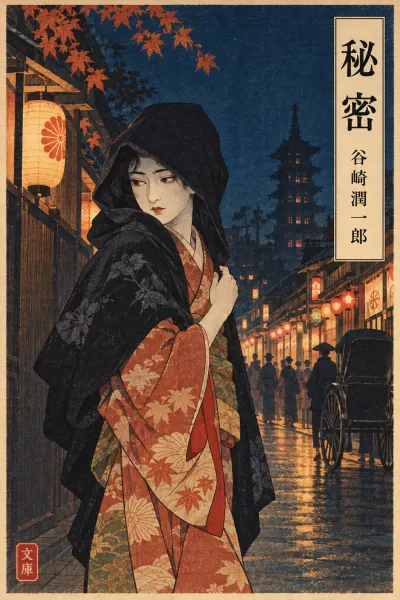
Part 10 of 11 · JLPT N1
秘密 Himitsu, part 10: The Street with the Seal-Maker's Sign
In this part
The narrator insists, and the woman reluctantly removes the cloth covering his eyes. He glimpses a lively, unfamiliar street with a seal-maker's signboard before she covers his eyes again and tearfully begs him to think of her only as a woman in a dream. Later he retraces the rickshaw's route on foot by daylight and finds the alley, but in the dry autumn sun it is a shabby, ordinary street near places he already knows, and his excitement fades.
AI translation · independently checked
いろいろに言葉を尽して頼んだが、私は何と云っても聴き入れなかった。She pleaded with me in every way she could, but whatever she said, I would not give in.
「仕方がない、そんなら見せて上げましょう。………その代り一寸ですよ。」"Very well, there is nothing for it — I shall let you see. ……But only for a moment, mind."
女は嘆息するように云って、力なく眼かくしの布を取りながら、The woman said this with something like a sigh, and as she listlessly drew away the cloth that bound my eyes,
「此処が何処だか判りますか。」"Do you know where we are?"
と、心許ない顔つきをした。she asked, with an uneasy look upon her face.
美しく晴れ渡った空の地色は、妙に黒ずんで星が一面にきらきらと輝き、白い霞のような天の川が果てから果てへ流れている。The ground of the beautifully clear sky was strangely dark, stars glittered across the whole of it, and the Milky Way, like a white haze, flowed from one end of the heavens to the other.
狭い道路の両側には商店が軒を並べて、燈火の光が賑やかに町を照らしていた。Along both sides of the narrow road the shops stood eaves to eaves, and the light of their lamps lit up the street in a lively glow.
不思議な事には、可なり繁華な通りであるらしいのに、私はそれが何処の街であるか、さっぱり見当が附かなかった。Strange to say, though it seemed to be a fairly busy thoroughfare, I had not the faintest idea what street it was.
俥はどんどんその通りを走って、やがて一二町先の突き当りの正面に、精美堂と大きく書いた印形屋の看板が見え出した。The rickshaw sped briskly along that street, and presently, a block or two ahead, straight in front of us where the road ended, there came into view the signboard of a seal-maker's shop, with the name Seibidō written on it in large characters.
私が看板の横に書いてある細い文字の町名番地を、俥の上で遠くから覗き込むようにすると、女は忽ち気が附いたか、When, from my seat in the rickshaw, I leaned forward to peer from afar at the street name and number written in fine characters beside the signboard, the woman seemed at once to realise what I was doing,
「あれッ」"Oh, no!"
と云って、再び私の眼を塞いで了った。she cried, and once more covered my eyes.
賑やかな商店の多い小路で突きあたりに印形屋の看板の見える街、―――どう考えて見ても、私は今迄通ったことのない往来の一つに違いないと思った。A narrow street full of lively shops, with a seal-maker's signboard visible at the end of it — however I considered it, I felt sure it must be one of the streets I had never yet walked along.
子供時代に経験したような謎の世界の感じに、再び私は誘われた。Once again I was drawn into that feeling of a world of riddles, such as I had known in my childhood.
「あなた、あの看板の字が読めましたか。」"Tell me, could you read what was written on that sign?"
「いや読めなかった。一体此処は何処なのだか私にはまるで判らない。私はお前の生活に就いては三年前の太平洋の波の上の事ばかりしか知らないのだ。私はお前に誘惑されて、何だか遠い海の向うの、幻の国へ伴れて来られたように思われる。」"No, I could not. I have no idea at all where on earth we are. Of your life I know nothing but what passed upon the waves of the Pacific three years ago. I feel as though you had seduced me and carried me off to some phantom country far across the sea."
私がこう答えると、女はしみじみとした悲しい声で、こんな事を云った。When I answered thus, the woman spoke these words in a voice full of quiet sorrow:
「後生だからいつまでもそう云う気持で居て下さい。幻の国に住む、夢の中の女だと思って居て下さい。もう二度と再び、今夜のような我が儘を云わないで下さい。」"I beg you, keep that feeling always. Think of me as a woman in a dream, who lives in a phantom country. And never again, I implore you, make such a wilful demand as you made tonight."
女の眼からは、涙が流れて居るらしかった。Tears, it seemed, were flowing from her eyes.
その後暫く、私は、あの晩女に見せられた不思議な街の光景を忘れることが出来なかった。For some time after that, I could not forget the scene of the strange street the woman had shown me that night.
燈火のかんかんともっている賑やかな狭い小路の突き当りに見えた印形屋の看板が、頭にはッきりと印象されて居た。The seal-maker's signboard I had seen at the end of that lively, narrow street, with its brightly burning lamps, was vividly imprinted on my mind.
何とかして、あの町の在りかを捜し出そうと苦心した揚句、私は漸く一策を案じ出した。After racking my brains over how I might somehow discover where that street lay, I at last hit upon a plan.
長い年月の間、毎夜のように相乗りをして引き擦り廻されて居るうちに、雷門で俥がくるくると一つ所を廻る度数や、右に折れ左に曲る回数まで、一定して来て、私はいつともなくその塩梅を覚え込んでしまった。Over the long years, as night after night I rode beside her and was dragged hither and thither, the number of times the rickshaw circled round and round on one spot at the Kaminarimon, and even the number of turns it took to the right and to the left, had become fixed, and before I knew it I had learnt the whole pattern by heart.
或る朝、私は雷門の角へ立って眼をつぶりながら二三度ぐるぐると体を廻した後、この位だと思う時分に、俥と同じ位の速度で一方へ駆け出して見た。One morning I stood at the corner of the Kaminarimon and, with my eyes shut, spun my body round two or three times; then, at the moment I judged to be about right, I set off running in one direction at roughly the speed of the rickshaw.
唯好い加減に時間を見はからって彼方此方の横町を折れ曲るより外の方法はなかったが、丁度この辺と思う所に、予想の如く、橋もあれば、電車通りもあって、確かにこの道に相違ないと思われた。There was no other method than to guess the timing as best I could and turn down one side street after another, here and there; yet just where I expected, sure enough, there was a bridge, and there was a tramline, and I felt certain this must be the very road.
道は最初雷門から公園の外郭を廻って千束町に出て、龍泉寺町の細い通りを上野の方へ進んで行ったが、車坂下で更に左へ折れ、お徒町の往来を七八町も行くとやがて又左へ曲り始める。The road first went from the Kaminarimon around the outer edge of the park and came out at Senzokuchō, then proceeded along the narrow street of Ryūsenjimachi toward Ueno; at Kurumazaka-shita it turned left again, and after going a good seven or eight blocks along the Okachimachi road, it presently began to bend to the left once more.
私は其処でハタとこの間の小路にぶつかった。There I suddenly came upon the narrow street of that night.
成る程正面に印形屋の看板が見える。Sure enough, straight ahead I could see the seal-maker's signboard.
それを望みながら、秘密の潜んでいる巌窟の奥を究めでもするように、つかつかと進んで行ったが、つきあたりの通りへ出ると、思いがけなくも、其処は毎晩夜店の出る下谷竹町の往来の続きであった。With my eyes fixed upon it, I strode forward as if probing the depths of a cavern where some secret lay hidden; but when I came out onto the street at the end, it turned out, quite unexpectedly, to be a continuation of the Shitaya Takechō road, where night stalls are set up every evening.
いつぞや小紋の縮緬を買った古着屋の店もつい二三間先に見えて居る。Even the second-hand clothes shop where some time ago I had bought the figured crêpe kimono was in sight, only a few yards away.
不思議な小路は、三味線堀と仲お徒町の通りを横に繋いで居る街路であったが、どうも私は今迄其処を通った覚えがなかった。The mysterious street was one that ran crosswise, linking Shamisenbori with the Naka-Okachimachi road, and yet I had no recollection of ever having passed along it before.
散々私を悩ました精美堂の看板の前に立って、私は暫く彳んで居た。I stood lingering for a while before the Seibidō signboard that had tormented me so much.
燦爛とした星の空を戴いて夢のような神秘な空気に蔽われながら、赤い燈火を湛えて居る夜の趣とは全く異り、秋の日にかんかん照り附けられて乾涸びて居る貧相な家並を見ると、何だか一時にがっかりして興が覚めて了った。It was altogether unlike the street at night, crowned with a sky of glittering stars, wrapped in a dreamlike, mysterious air, and brimming with red lamplight; when I saw the shabby row of houses parched and dried out under the blazing autumn sun, I felt somehow disappointed all at once, and my fascination cooled.
Vocabulary
| Word | Meaning | JLPT |
|---|---|---|
| 尽してつくす | to use up; to do everything possibledictionary form: 尽くす言葉を尽くす: to plead or explain using every possible word. | N1 |
| 嘆息たんそく | a sigh (of grief or resignation)Literary; everyday Japanese uses ため息. | — |
| 心許ないこころもとない | uneasy, anxious, insecure | — |
| 見当けんとう | an idea, a guess見当が付かない: to have no idea. 附 is an older spelling of 付. | N3 |
| 印形屋いんぎょうや | seal-maker's shop印形 is an old word for a personal name seal (today 判子・印鑑). There is no exact English equivalent. | — |
| 往来おうらい | street, thoroughfareAlso means 'coming and going, traffic'. Old-fashioned in the sense of 'road'. | — |
| 後生ごしょうだから | I beg you, for pity's sakedictionary form: 後生だからBuddhist in origin ('the next life'). Read こうせい, it means 'younger generation'. | — |
| 我が儘わがまま | selfishness; a wilful demandUsually written in kana today. | N3 |
| 揚句あげく | in the end, after (much effort)dictionary form: 挙げ句Today usually written 挙げ句 or あげく. | — |
| 塩梅あんばい | the way things go; the pattern or knackOriginally 'seasoning'; now also 'condition' or 'state of things'. | — |
| 相違そうい | difference〜に相違ない is a formal 〜に違いない: 'it must be'. | N2 |
| 夜店よみせ | night stall, street stall open in the evening | — |
| 彳んでたたずむ | to stand still, to lingerdictionary form: 佇む彳 is a rare variant; the standard kanji is 佇. | — |
| 興きょう | interest, excitement興が覚める: to lose interest, to have the spell broken. | — |
Grammar
〜て上げましょう N4 I'll (do something) for you
て-form plus 上げる offers to do something for the listener; ましょう makes it a polite, resigned offer. Here T reluctantly agrees to show him where they are.
そんなら見せて上げましょう。
Then I shall let you see.
〜に違いない N3 must be; there is no doubt that
This expresses a strong conviction drawn from reasoning. The narrator concludes that the street must be one he has never walked along.
私は今迄通ったことのない往来の一つに違いないと思った。
I felt sure it must be one of the streets I had never walked along.
〜ように思われる N3 it seems as though; I can't help feeling that
The spontaneous passive 思われる presents an impression that arises by itself rather than a deliberate opinion. Combined with ように, it means 'it feels as if'.
幻の国へ伴れて来られたように思われる。
I feel as though I have been carried off to a phantom country.
〜た揚句 N2 after (much effort or trouble), finally
Attached to a past-tense verb, it marks the end result of a long, often troublesome process. Here a plan emerges only after much racking of brains.
苦心した揚句、私は漸く一策を案じ出した。
After racking my brains, I at last hit upon a plan.
〜より外(ほか)はない N3 there is no choice but to
〜より外(ほか)はない / 〜ほかない: there is nothing to do but ...; there is no choice but to .... Here the variant 〜より外の方法はない means 'there is no other method than ...'. 外 is read ほか and means 'other'.
彼方此方の横町を折れ曲るより外の方法はなかった
there was no other method than to turn down side streets here and there
〜でもするように N2 as if (one were) doing something like
The particle でも softens the action ('something like'), and ように turns the whole into a simile. Here it describes his manner of walking as if he were exploring a cavern.
秘密の潜んでいる巌窟の奥を究めでもするように、つかつかと進んで行った
I strode forward as if probing the depths of a cavern where a secret lay hidden