Part 3 of 11 · JLPT N1
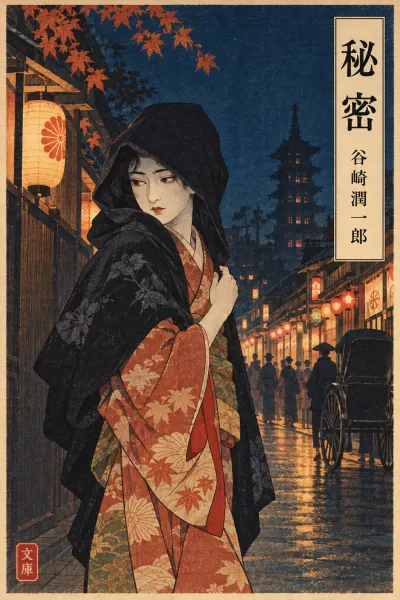
秘密 Himitsu, part 3: A Room of Incense and Strange Books
In this part
The narrator packs away his serious books and fills his temple room with books on magic, crime and anatomy, old Buddhist paintings and burning incense, and spends his days lost in fantasies. At night he drinks whisky, slips out over the graveyard hedge and wanders Asakusa in a different disguise each time. One evening he sees a woman's crêpe kimono in an old-clothes shop, and his love of fine silk drives him to buy it so that he can walk the streets dressed as a woman.
AI translation · independently checked
それから私は、今迄親しんで居た哲学や芸術に関する書類を一切戸棚へ片附けて了って、魔術だの、催眠術だの、探偵小説だの、化学だの、解剖学だのの奇怪な説話と挿絵に富んでいる書物を、さながら土用干の如く部屋中へ置き散らして、寝ころびながら、手あたり次第に繰りひろげては耽読した。Thereafter I put away in the cupboard every last one of the books on philosophy and art that had until then been my familiar companions. In their place I scattered volumes all over the room, as though airing them in the midsummer sun: books rich in grotesque tales and illustrations of sorcery, of hypnotism, of detective fiction, of chemistry, of anatomy. Lying sprawled among them, I would open whichever came to hand and lose myself in reading.
その中には、コナンドイルの The Sign of Four や、ドキンシイの Murder, Considered as one of the fine arts や、アラビアンナイトのようなお伽噺から、仏蘭西の不思議な Sexuology の本なども交っていた。Among them were Conan Doyle's The Sign of Four, De Quincey's Murder, Considered as one of the fine arts, fairy tales such as the Arabian Nights, and even curious French books on Sexuology.
此処の住職が秘していた地獄極楽の図を始め、須弥山図だの涅槃像だの、いろいろの、古い仏画を強いて懇望して、丁度学校の教員室に掛っている地図のように、所嫌わず部屋の四壁へぶら下げて見た。I pressed the priest of the temple until he parted with the pictures of Hell and Paradise he had kept hidden away. With them came pictures of Mount Sumeru, images of the Buddha entering Nirvana and all manner of other old Buddhist paintings, and I hung them without regard for place on all four walls of my room, just like the maps that hang in a school staff room.
床の間の香炉からは、始終紫色の香の煙が真っ直ぐに静かに立ち昇って、明るい暖かい室内を焚きしめて居た。From the incense burner in the alcove, purple incense smoke rose ceaselessly, straight and quiet, steeping the bright, warm room in its fragrance.
私は時々菊屋橋際の舗へ行って白檀や沈香を買って来てはそれを燻べた。Every so often I would go to a shop at the foot of Kikuyabashi, buy sandalwood and aloeswood, and bring them back to burn.
天気の好い日、きらきらとした真昼の光線が一杯に障子へあたる時の室内は、眼の醒めるような壮観を呈した。On fine days, when the glittering midday light fell full upon the paper screens, the room presented a dazzling spectacle.
絢爛な色彩の古画の諸仏、羅漢、比丘、比丘尼、優婆塞、優婆夷、象、獅子、麒麟などが四壁の紙幅の内から、ゆたかな光の中に泳ぎ出す。From within the hanging scrolls on the four walls, the figures of those old, gorgeously coloured paintings came swimming out into the abundant light: Buddhas, arhats, monks and nuns, lay brothers and lay sisters, elephants, lions and kirin.
畳の上に投げ出された無数の書物からは、惨殺、麻酔、魔薬、妖女、宗教―――種々雑多の傀儡が、香の煙に溶け込んで、朦朧と立ち罩める中に、二畳ばかりの緋毛氈を敷き、どんよりとした蛮人のような瞳を据えて、寝ころんだ儘、私は毎日々々幻覚を胸に描いた。From the countless books flung down upon the tatami, all manner of puppets (slaughter, anaesthesia, sorcerous drugs, witches, religion) melted into the incense smoke and hung there in a dim haze. In the midst of it I spread a scarlet felt rug about two mats in size and lay sprawled on it, fixing my dull eyes like a savage's, and day after day I painted hallucinations in my breast.
夜の九時頃、寺の者が大概寝静まって了うとウヰスキーの角壜を呷って酔いを買った後、勝手に縁側の雨戸を引き外し、墓地の生け垣を乗り越えて散歩に出かけた。Around nine at night, when nearly everyone at the temple had gone quietly to sleep, I would gulp from a square bottle of whisky until I was drunk. Then, without asking anyone's leave, I would take down a storm shutter on the veranda, climb over the hedge of the graveyard and go out for a stroll.
成る可く人目にかからぬように毎晩服装を取り換えて公園の雑沓の中を潜って歩いたり、古道具屋や古本屋の店先を漁り廻ったりした。So as to escape notice as far as possible, I changed my clothes every night, slipping through the throngs in the park or roaming from shopfront to shopfront among the junk dealers and second-hand booksellers.
頬冠りに唐桟の半纏を引っ掛け、綺麗に研いた素足へ爪紅をさして雪駄を穿くこともあった。At times I would wrap a cloth about my head and cheeks, throw on a workman's coat of striped cotton, paint the nails of my beautifully polished bare feet with red, and slip on leather-soled sandals.
金縁の色眼鏡に二重廻しの襟を立てて出ることもあった。At other times I went out in gold-rimmed tinted spectacles, with the collar of my caped cloak turned up.
着け髭、ほくろ、痣と、いろいろに面体を換えるのを面白がったが、或る晩、三味線堀の古着屋で、藍地に大小あられの小紋を散らした女物の袷が眼に附いてから、急にそれが着て見たくてたまらなくなった。I delighted in changing my face in every possible way: false whiskers, moles, birthmarks. But one evening, at a second-hand clothes shop in Shamisenbori, my eye fell on a woman's lined kimono with a fine pattern of hailstone dots, large and small, scattered over an indigo ground. From that moment I was seized by an unbearable longing to try it on.
一体私は衣服反物に対して、単に色合が好いとか柄が粋だとかいう以外に、もっと深く鋭い愛着心を持って居た。In truth, I had always felt toward garments and bolts of cloth an attachment far deeper and keener than any mere liking for a pleasing colour or a stylish pattern.
女物に限らず、凡べて美しい絹物を見たり、触れたりする時は、何となく顫い附きたくなって、丁度恋人の肌の色を眺めるような快感の高潮に達することが屡々であった。Not only with women's clothes, but whenever I looked at or touched any beautiful silk at all, I would somehow long to tremble and cling to it, and often I reached a climax of pleasure like that of gazing upon the colour of a lover's skin.
殊に私の大好きなお召や縮緬を、世間憚らず、恣に着飾ることの出来る女の境遇を、嫉ましく思うことさえあった。I even, at times, envied the lot of women, who may adorn themselves freely and without fear of the world's opinion in the omeshi silks and crêpes I loved so dearly.
あの古着屋の店にだらりと生々しく下って居る小紋縮緬の袷―――あのしっとりした、重い冷たい布が粘つくように肉体を包む時の心好さを思うと、私は思わず戦慄した。That lined kimono of figured crêpe, hanging so limp and so vividly alive in the old-clothes shop! When I imagined the delight of that moist, heavy, cool fabric clinging to my flesh and wrapping it close, I shuddered in spite of myself.
あの着物を着て、女の姿で往来を歩いて見たい。I want to put on that kimono and try walking the streets in the guise of a woman.
………こう思って、私は一も二もなくそれを買う気になり、ついでに友禅の長襦袢や、黒縮緬の羽織迄も取りそろえた。…With this thought I made up my mind to buy it without a moment's hesitation, and while I was about it I gathered together a long under-kimono dyed in yūzen and even a half-coat of black crêpe.
Vocabulary
| Word | Meaning | JLPT |
|---|---|---|
| 耽読たんどくする | to read absorbedly, to be engrossed in booksdictionary form: 耽読する耽 means to indulge in something; compare 耽る (ふける). | — |
| 懇望こんもうする | to beg earnestly, to entreatdictionary form: 懇望するAlso read こんぼう. Here it is strengthened by 強いて, 'insistently'. | — |
| 焚きしめてたきしめる | to perfume thoroughly with burning incensedictionary form: 焚きしめるClassical expression, often used of scenting clothes or rooms. | — |
| 壮観そうかん | magnificent sight, spectacle壮観を呈する is a set phrase: 'to present a splendid sight'. | — |
| 麒麟きりん | kirin, an auspicious mythical beast of Chinese legendA hooved, horned creature sometimes likened to a unicorn. In modern Japanese the same word also means 'giraffe'. | — |
| 朦朧もうろう | dim, hazy, vagueCommon in 意識が朦朧とする, 'to be semi-conscious'. | — |
| 漁り廻ったあさりまわる | to rummage around, to hunt through (many places)dictionary form: 漁り回る漁る literally means 'to fish'; figuratively it means to search eagerly. 廻 is an old spelling of 回. | — |
| 面体めんてい | facial features, looksOld-fashioned word, often used of a suspicious person's appearance. | — |
| 袷あわせ | lined kimonoWorn in autumn and spring, as opposed to the unlined 単衣 (ひとえ). | — |
| 屡々しばしば | often, frequentlyUsually written in kana today; 々 repeats the preceding kanji. | N1 |
| お召おめし | omeshi, a high-quality crêpe silk woven from pre-dyed threadsShort for お召縮緬. The name comes from 召す, an honorific verb for 'to wear'. | — |
| 恣ほしいまま | as one pleases, without restraintLiterary word. 恣に is used adverbially: 'freely, at will'. | — |
| 戦慄せんりつする | to shudder, to trembledictionary form: 戦慄するUsually from fear, but here from sensual excitement. | — |
| 友禅ゆうぜん | yūzen, a resist-dyeing technique producing colourful painted patterns on silkNamed after the Edo-period painter Miyazaki Yūzensai. | — |
Grammar
〜だの〜だの N2 things like A and B; A, B and so on
Lists examples in a loose, casual or slightly disparaging way. Here a long string of だの piles up the strange subjects of the books, and the final だのの links the whole list to the noun that follows.
魔術だの、催眠術だの、探偵小説だの、化学だの、解剖学だのの奇怪な説話と挿絵に富んでいる書物
books rich in grotesque tales and illustrations of sorcery, hypnotism, detective fiction, chemistry, anatomy and the like
〜の如く N1 like, as if
Literary equivalent of 〜のように. It is often paired with さながら ('just as if') to introduce a vivid comparison.
さながら土用干の如く部屋中へ置き散らして
scattering them all over the room as though airing them in the midsummer sun
〜ては N3 (repeatedly) do A and then B
The て-form plus は describes a habitual sequence of actions that is repeated over and over. Here buying incense and burning it is a recurring routine.
白檀や沈香を買って来てはそれを燻べた
I would buy sandalwood and aloeswood, bring them back and burn them
〜たくてたまらない N3 to want to do something unbearably
たまらない after the て-form of an adjective or desire expresses a feeling too strong to endure. Here it combines with 〜てみたい and なる to show a sudden, overwhelming urge.
急にそれが着て見たくてたまらなくなった
I was suddenly seized by an unbearable longing to try it on
〜に限らず N3 not only, not limited to
Indicates that what follows applies more widely than the noun mentioned. Here his passion extends beyond women's clothing to all fine silk.
女物に限らず、凡べて美しい絹物を見たり、触れたりする時は
Not only with women's clothes, but whenever I looked at or touched any beautiful silk
〜ことさえある N3 there are even times when…
さえ marks an extreme example ('even'), and 〜ことがある expresses an occasional occurrence. Together they present envying women as the furthest point his feelings sometimes reached.
女の境遇を、嫉ましく思うことさえあった
I even, at times, envied the lot of women