Upper intermediate · JLPT N2
グッド・バイGuddobai — The Goodbye Parade
- JLPT N2
- 14,586 characters
- 13 parts
- about 122 minutes
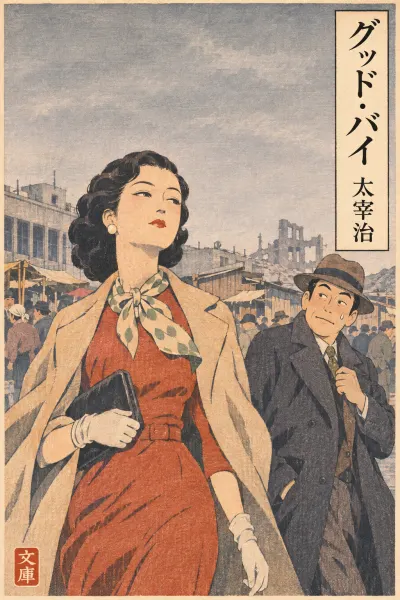
グッド・バイ is a comic novel set in the black markets and bombed-out districts of Tokyo three years after the war. Tajima Shūji is a magazine editor who has grown rich on black-market deals. He is married and keeps nearly ten mistresses, and he has decided to give them all up and settle down. Acting on a dissolute old writer's advice, he hires Kinuko, a crow-voiced black-market carrier who turns out to be a startling beauty, to pose as his wife on a tour of farewells. The comedy comes from her appetite, her greed and her fists, and from his own pettiness. The narrator keeps cutting in to mock Tajima, and the prose moves in short, clipped sentences. This was the novel Dazai was working on when he died in 1948, and it is unfinished. For a learner, the plain-form narration is manageable. The dialogue is harder: Kinuko's coarse slang and bungled idioms, Tajima's nervous politeness, and a soldier's stiff military speech all sit side by side. Comparing these voices is good practice in how Japanese marks class, gender and mood.
Contents
- An Editor Resolves to Quit Everything (変心 (一))
- A Ridiculous Plan Takes Shape (変心 (二))
- Hunting for a Stunning Beauty (行進 (一))
- Kinuko Dressed Up and Eating (行進 (二))
- A Feast, Two Conditions, and a Mixed-Up Idiom (行進 (三))
- First Stop: The Hairdresser's Defeat (行進 (四))
- A Tender Farewell, a Costly Shopping Spree (行進 (五))
- Tajima Plots Revenge and Visits Kinuko (怪力 (一))
- Whisky, Fish Roe, and a Shameless Bargain (怪力 (二))
- Mullet Roe and a Secret Closet (怪力 (三))
- A Seduction Goes Badly Wrong (怪力 (四))
- A Moral Debate Turns into Haggling (コールド・ウォー (一))
- Plan to Use Kinuko as Bodyguard (コールド・ウォー (二))
Before you read
- Get used to the intrusive narrator. He often steps outside the action to comment on Tajima, frequently with sarcasm. If a sentence is evaluating Tajima rather than describing an event, it is usually the narrator speaking, and that can be read differently from the plot.
- Track who is speaking by register. Kinuko uses blunt, coarse slang and gets set phrases wrong; she confuses 背水の陣 with spilt water, and the joke depends on noticing the mistake. Tajima turns politely nervous with her and shows a faint Kansai trace. Keiko's soldier brother uses the stiff military 自分は…であります.
- Learn the postwar black-market vocabulary first, because it appears throughout: 闇市 / ヤミ (black market), 担ぎ屋 (illegal goods carrier), 愛人 (lover), 女房 (wife), and money talk such as 円 amounts and 日当 (daily pay) in the haggling scenes.
- Use the place names as anchors: 新宿, 世田谷, 日本橋, 築地 and 田園調布 each mark a different scene or lover, so they help you keep track of where you are in the story.
Words to know
The most useful words from the notes across the story.
| Word | Meaning | JLPT |
|---|---|---|
| 怪力かいりき | superhuman strength | — |
| ケチけち | stingy; a miserdictionary form: けちVery common insult. ケチねえ = 'how stingy!' | N3 |
| 憂鬱ゆううつ | gloomy, depressedA famously hard kanji pair; often written ゆううつ. | N1 |
| 気品きひん | grace, elegance, refined dignity | N1 |
| 下心したごころ | ulterior motive, hidden schemeOften implies a selfish or romantic intention. | N1 |
| 足を洗いあしをあらう | to wash one's hands of, to quit (a shady business)dictionary form: 足を洗う | — |
| 泣きべそなきべそ | a face about to burst into tears泣きべそをかく / 泣きべその顔になる: to look as if one is about to cry, often said of children. | — |
| 律儀りちぎ | conscientious, scrupulously faithfulSomeone who keeps his promises and obligations carefully. | — |
| 虚栄心きょえいしん | vanity, conceit虚栄 'empty glory' + 心 'heart'. | — |
| ゲスげす | vulgar, low-classdictionary form: 下衆Often written 下種 or 下衆; a harsh word for coarse behaviour or speech. | — |
| 失敬しっけい | rude, impoliteSomewhat old-fashioned, mostly masculine word. | — |
| 別離べつり | parting, separationFormal, literary word; everyday Japanese would use 別れ. | — |
| 荒涼こうりょう | desolate, bleakLiterary word, usually used of landscapes. Applying it to a room is comic exaggeration. | — |
| 押入れおしいれ | built-in closet (for futons and belongings)dictionary form: 押し入れ | N4 |
| 承知しょうち | consent, agreement | N4 |
Plot summary
Show the full summary (contains spoilers)
After a funeral, Tajima, a rich editor and black-market dealer, tells an aging writer he wants to drop his many mistresses and live a settled family life. The writer suggests he find a stunning beauty to pose as his wife and visit each lover with her. Tajima finds no one until, by chance, he meets Kinuko in the black market behind Shinjuku Station. She is a grubby carrier who cleans up beautifully. He pays for her lost earnings on condition that she neither speaks nor eats in front of others. Their first visit leaves the hairdresser Aoki in quiet tears, and Kinuko then spends freely from his wallet. She punches him and he stumbles out. He phones her to haggle over her fee: she holds out for ten thousand yen and he raises his offer to five thousand, and her chuckle signals agreement. He then plans to visit the painter Keiko, whose burly brother is just back from Siberia. The story breaks off unfinished.
About the author
Dazai Osamu (太宰治) was the pen name of Tsushima Shūji, born into a wealthy landowning family in Aomori Prefecture in northern Japan. He studied French literature at Tokyo Imperial University but did not graduate, devoting himself instead to writing. He is best known for the novels The Setting Sun (斜陽) and No Longer Human (人間失格), which draw heavily on his own troubled life. Much of his work is dark and confessional. Keep Running, Melos shows a brighter, more straightforwardly heroic side of his writing. He died by suicide in 1948.