Part 4 of 13 · JLPT N2
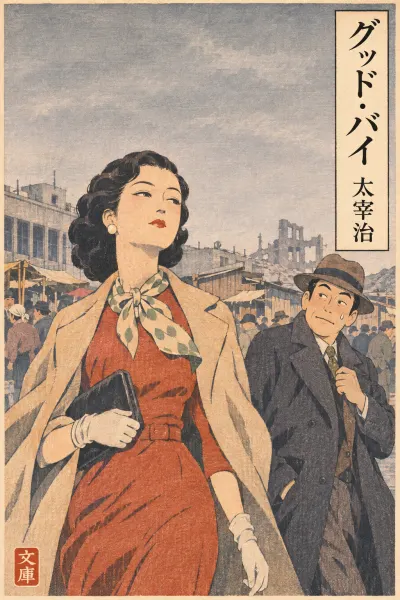
グッド・バイ(行進 (二)) Guddobai, part 4: Kinuko Dressed Up and Eating
In this part
Tajima meets Kinuko, the black-market carrier, who is so splendidly dressed that she is hardly recognisable, though her coarse voice spoils the illusion. He takes her to a black-market restaurant he knows and explains the favour he wants, while she eats her way through the food without a care. When he asks if she will help, she calls him an idiot and says the whole thing is hopeless.
AI translation · independently checked
馬子にも衣裳というが、ことに女は、その装い一つで、何が何やらわけのわからぬくらいに変る。They say fine clothes can make even a packhorse driver look grand, and women especially can be so changed by their clothes alone that you can no longer make head or tail of them.
元来、化け物なのかも知れない。Perhaps they are shape-shifting monsters by nature.
しかし、この女(永井キヌ子という)のように、こんなに見事に変身できる女も珍らしい。Still, a woman who could transform herself as splendidly as this one (her name was Nagai Kinuko) was a rare thing.
「さては、相当ため込んだね。いやに、りゅうとしてるじゃないか。」"Well, well, you must have stashed away a tidy pile. Aren't you looking awfully swanky!"
「あら、いやだ。」"Oh, get away with you."
どうも、声が悪い。That voice really was dreadful.
高貴性も何も、一ぺんに吹き飛ぶ。All her air of nobility, and everything else, was blown away in an instant.
「君に、たのみたい事があるのだがね。」"There's something I'd like to ask of you, you see."
「あなたは、ケチで値切ってばかりいるから、……」"You're such a cheapskate, always haggling the price down..."
「いや、商売の話じゃない。ぼくはもう、そろそろ足を洗うつもりでいるんだ。君は、まだ相変らず、かついでいるのか。」"No, it's nothing to do with business. I'm planning to wash my hands of all that pretty soon. Are you still hauling goods, same as ever?"
「あたりまえよ。かつがなきゃおまんまが食べられませんからね。」"Course I am. If I don't haul, I don't get any grub, do I?"
言うことが、いちいちゲスである。Every single thing she said was vulgar.
「でも、そんな身なりでも無いじゃないか。」"But you're hardly dressed for that sort of work."
「そりゃ、女性ですもの。たまには、着飾って映画も見たいわ。」"Well, I'm a woman, aren't I? Every now and then I want to dress up and see a film too."
「きょうは、映画か?」"So it's the pictures today?"
「そう。もう見て来たの。あれ、何ていったかしら、アシクリゲ、……」"That's right. I've already been. What was it called again... Shank's Leg, or something..."
「膝栗毛だろう。ひとりでかい?」"Shank's Mare, you mean. Did you go on your own?"
「あら、いやだ。男なんて、おかしくって。」"Oh, don't be silly. Men are just a joke."
「そこを見込んで、頼みがあるんだ。一時間、いや、三十分でいい、顔を貸してくれ。」"That's exactly why I'm counting on you. I have a favour to ask. Give me an hour — no, thirty minutes will do — just come along with me."
「いい話?」"Is it a good deal?"
「君に損はかけない。」"You won't lose anything by it."
二人ならんで歩いていると、すれ違うひとの十人のうち、八人は、振りかえって、見る。As the two of them walked side by side, eight out of every ten people who passed them turned round to look.
田島を見るのでは無く、キヌ子を見るのだ。They were not looking at Tajima; they were looking at Kinuko.
さすが好男子の田島も、それこそすごいほどのキヌ子の気品に押されて、ゴミっぽく、貧弱に見える。Even Tajima, handsome fellow that he was, was overwhelmed by Kinuko's truly formidable elegance and looked shabby and puny, like a bit of rubbish.
田島はなじみの闇の料理屋へキヌ子を案内する。Tajima took Kinuko to a black-market restaurant where he was a regular.
「ここ、何か、自慢の料理でもあるの?」"Have they got some special dish they're proud of here?"
「そうだな、トンカツが自慢らしいよ。」"Let me see... Their pork cutlet is supposed to be the speciality."
「いただくわ。私、おなかが空いてるの。それから、何が出来るの?」"I'll have that. I'm ever so hungry. And what else can they make?"
「たいてい出来るだろうけど、いったい、どんなものを食べたいんだい。」"They can make most things, I expect, but what on earth is it you want to eat?"
「ここの自慢のもの。トンカツの他に何か無いの?」"Whatever they're proud of here. Isn't there anything besides the pork cutlet?"
「ここのトンカツは、大きいよ。」"The pork cutlets here are big, you know."
「ケチねえ。あなたは、だめ。私奥へ行って聞いて来るわ。」"What a tightwad. You're hopeless. I'll go round the back and ask myself."
怪力、大食い、これが、しかし、全くのすごい美人なのだ。Monstrous strength, a monstrous appetite — and yet she was, without question, a stunning beauty.
取り逃がしてはならぬ。He must not let her slip through his fingers.
田島はウイスキイを飲み、キヌ子のいくらでもいくらでも澄まして食べるのを、すこぶるいまいましい気持でながめながら、彼のいわゆる頼み事について語った。Tajima drank whisky and, watching with deep irritation as Kinuko ate on and on with a perfectly composed face, explained what he called his favour.
キヌ子は、ただ食べながら、聞いているのか、いないのか、ほとんど彼の物語りには興味を覚えぬ様子であった。Kinuko simply went on eating; it was hard to tell whether she was listening or not, and she seemed to take almost no interest in his story.
「引受けてくれるね?」"You'll do it for me, won't you?"
「バカだわ、あなたは。まるでなってやしないじゃないの。」"You're an idiot, you are. The whole thing's just hopeless, isn't it?"
Vocabulary
| Word | Meaning | JLPT |
|---|---|---|
| 馬子にも衣裳まごにもいしょう | fine clothes make even a packhorse driver look good; clothes make the manProverb; 馬子 is an old word for a man who leads packhorses, a byword for a lowly, rough person. | — |
| 変身へんしん | transformation; changing one's appearance completely変身する / 変身できる. Echoes 化け物 (shape-shifting monster) in the previous sentence. | — |
| ため込んだためこむ | to save up, hoard, stash away (money)dictionary form: ため込むOften written 貯め込む. | — |
| りゅうとしてるりゅうとしている | smartly dressed, dashing, swankydictionary form: りゅうとしているOld-fashioned colloquial expression for someone dressed in fine clothes. | — |
| 値切ってねぎる | to haggle, beat down the pricedictionary form: 値切る値 (price) + 切る (cut). | — |
| 足を洗うあしをあらう | to wash one's hands of something; to quit a shady line of workIdiom: literally 'wash one's feet'. Used for leaving crime, gangs or other dubious trades. | — |
| かついでかつぐ | to carry on one's back or shoulder; here, to work as a black-market carrierdictionary form: かつぐPostwar slang for hauling goods from the countryside to sell on the black market. Kanji: 担ぐ. | N2 |
| おまんまおまんま | food, grub (rice; one's daily bread)Coarse, old-fashioned colloquial word; おまんまが食べられない = can't make a living. | — |
| ゲスげす | vulgar, low-classdictionary form: 下衆Often written 下種 or 下衆; a harsh word for coarse behaviour or speech. | — |
| 着飾ってきかざる | to dress up, put on one's finerydictionary form: 着飾る着る (wear) + 飾る (decorate). | N1 |
| 顔を貸してかおをかす | to come along with someone for a while (at their request)dictionary form: 顔を貸すIdiom: literally 'lend one's face'; a rough, casual way to say 'come with me for a bit'. | — |
| 気品きひん | grace, elegance, refined dignity | N1 |
| 闇やみ | black market; illegal (trading)Literally 'darkness'. In postwar Japan 闇 before a noun meant black-market: 闇市, 闇の料理屋. | N1 |
| いまいましいいまいましい | irritating, galling, vexingKanji: 忌々しい. Describes the annoyance of something you can't stop. | — |
Grammar
〜かも知れない N4 may, might, perhaps
Attached to a plain form (here のだ → なの) to express possibility. The narrator half-jokingly suggests that women might be monsters at heart.
元来、化け物なのかも知れない。
Perhaps they are shape-shifting monsters by nature.
〜てばかりいる N3 do nothing but ~; always ~
The て-form + ばかりいる says someone keeps doing the same thing, usually as a complaint. Kinuko grumbles that Tajima is forever haggling.
あなたは、ケチで値切ってばかりいるから、……
You're such a cheapskate, always haggling the price down...
〜なきゃ (〜なければ) N3 if one doesn't ~
なきゃ is the casual spoken contraction of なければ. Here it gives the condition: without hauling goods, she can't eat.
かつがなきゃおまんまが食べられませんからね。
If I don't haul, I don't get any grub, do I?
〜ぬ (literary negative) N2 not (= ない)
ぬ is an older, literary negative ending used in the narration in place of ない. わからぬ = わからない, and てはならぬ = てはならない ('must not').
取り逃がしてはならぬ。
He must not let her slip through his fingers.
〜のでは無く、〜のだ N3 it is not that ~, but that ~
This sets up a contrast: the first clause states what is not the case, and the second gives what is. It stresses that every glance is aimed at Kinuko.
田島を見るのでは無く、キヌ子を見るのだ。
They were not looking at Tajima; they were looking at Kinuko.
〜のか、〜ないのか N2 whether ~ or not
Two questions placed side by side show that something is unclear. The verb is left out of the second half: 聞いているのか、(聞いて)いないのか.
聞いているのか、いないのか、ほとんど彼の物語りには興味を覚えぬ様子であった。
It was hard to tell whether she was listening or not, and she seemed to take almost no interest in his story.