Part 2 of 13 · JLPT N2
グッド・バイ(変心 (二)) Guddobai, part 2: A Ridiculous Plan Takes Shape
In this part
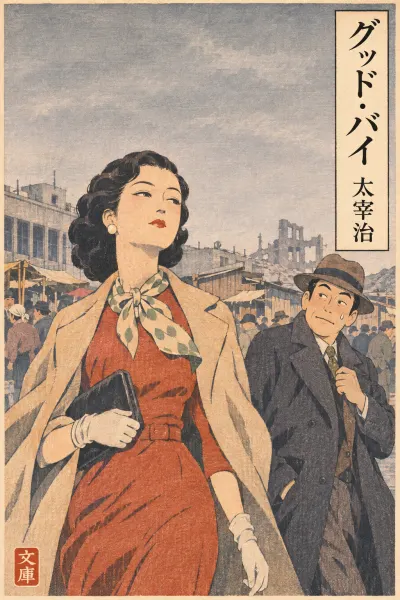
Tajima confesses his tangle of love affairs to the aging, dissolute writer, who teases him for being a weepy, oddly moral ladies' man. After proposing an absurd mass 'graduation ceremony', the writer suggests Tajima find a stunning beauty to pose as his wife and visit each lover with her. Desperate, Tajima starts to find the idea tempting.
AI translation · independently checked
田島は、泣きべその顔になる。Tajima's face crumples as if he's about to cry.
思えば、思うほど、自分ひとりの力では、到底、処理の仕様が無い。The more he thinks about it, the clearer it is that he can't possibly sort this out on his own.
金ですむ事なら、わけないけれども、女たちが、それだけで引下るようにも思えない。If money could settle it, it would be no trouble at all, but he can't imagine the women backing off for that alone.
「いま考えると、まるで僕は狂っていたみたいなんですよ。とんでもなく、手をひろげすぎて、……」"Looking back now, it's like I'd gone clean out of my mind. I spread myself far too thin, ..."
この初老の不良文士にすべて打ち明け、相談してみようかしらと、ふと思う。It suddenly occurs to him that he might confide everything to this aging, disreputable writer and ask his advice.
「案外、殊勝な事を言いやがる。もっとも、多情な奴に限って奇妙にいやらしいくらい道徳におびえて、そこがまた、女に好かれる所以でもあるのだがね。男振りがよくて、金があって、若くて、おまけに道徳的で優しいと来たら、そりゃ、もてるよ。当り前の話だ。お前のほうでやめるつもりでも、先方が承知しないぜ、これは。」"Well, who'd have thought—you're actually saying something admirable. Mind you, it's always the skirt-chasers who get scared of morality to a downright creepy degree, and that's exactly why the women go for them, too. Good-looking, money in your pocket, young, and on top of that decent and kind to boot? Why, of course they flock to you. Stands to reason. You may mean to call it quits, but the other side won't stand for it, you know."
「そこなんです。」"That's just it."
ハンケチで顔を拭く。He wipes his face with a handkerchief.
「泣いてるんじゃねえだろうな。」"You're not crying, are you?"
「いいえ、雨で眼鏡の玉が曇って、……」"No, the rain's fogged up my glasses, ..."
「いや、その声は泣いてる声だ。とんだ色男さ。」"Nope, that's a crying voice. Some ladies' man you are."
闇商売の手伝いをして、道徳的も無いものだが、その文士の指摘したように、田島という男は、多情のくせに、また女にへんに律儀な一面も持っていて、女たちは、それ故、少しも心配せずに田島に深くたよっているらしい様子。For a man who helps out in black-market dealing, morality is hardly the word, but as the writer pointed out, Tajima, philanderer though he is, also has a strangely conscientious side toward women, and for that very reason the women seem to rely on him deeply without the slightest worry.
「何か、いい工夫が無いものでしょうか。」"Isn't there some good way out of this?"
「無いね。お前が五、六年、外国にでも行って来たらいいだろうが、しかし、いまは簡単に洋行なんか出来ない。"Nope. If you went abroad for five or six years, that'd do it, but these days you can't just pop off overseas.
いっそ、その女たちを全部、一室に呼び集め、蛍の光でも歌わせて、いや、仰げば尊し、のほうがいいかな、お前が一人々々に卒業証書を授与してね、それからお前は、発狂の真似をして、まっぱだかで表に飛び出し、逃げる。Tell you what: round up all those women in one room and have them sing 'Auld Lang Syne'—no, wait, maybe the graduation song thanking our teachers would be better—and you hand each one of them a graduation certificate, and then you pretend you've gone mad, run out the front door stark naked, and make your getaway.
これなら、たしかだ。女たちも、さすがに呆れて、あきらめるだろうさ。」That's a sure thing. Even they'll be too flabbergasted to do anything but give up."
まるで相談にも何もならぬ。It's no kind of advice at all.
「失礼します。僕は、あの、ここから電車で、……」"I'll be going, then. I, um, I'll take the streetcar from here, ..."
「まあ、いいじゃないか。つぎの停留場まで歩こう。何せ、これは、お前にとって重大問題だろうからな。二人で、対策を研究してみようじゃないか。」"Oh, come on, what's the rush? Let's walk to the next stop. After all, this must be a serious problem for you. Let's put our heads together and work out a strategy, shall we?"
文士は、その日、退屈していたものと見えて、なかなか田島を放さぬ。The writer must have been bored that day, because he simply won't let Tajima go.
「いいえ、もう、僕ひとりで、何とか、……」"No, really, I'll manage somehow on my own, ..."
「いや、いや、お前ひとりでは解決できない。まさか、お前、死ぬ気じゃないだろうな。"No, no, you can't solve this on your own. Good Lord, you're not thinking of killing yourself, are you?
実に、心配になって来た。女に惚れられて、死ぬというのは、これは悲劇じゃない、喜劇だ。Now I'm really getting worried. Dying because women are crazy about you—that's no tragedy, that's a comedy.
いや、ファース(茶番)というものだ。滑稽の極だね。誰も同情しやしない。死ぬのはやめたほうがよい。No, it's what they call a farce. The height of absurdity. Nobody'd feel the least bit sorry for you. You'd better drop the idea of dying.
うむ、名案。すごい美人を、どこからか見つけて来てね、そのひとに事情を話し、お前の女房という形になってもらって、それを連れて、お前のその女たち一人々々を歴訪する。Hmm, I've got it. You dig up some stunning beauty from somewhere, explain the situation to her, get her to pose as your wife, and take her along on a round of visits to each and every one of those women of yours.
効果てきめん。女たちは、皆だまって引下る。どうだ、やってみないか。」Works like a charm. Every one of them backs off without a word. Well? Want to give it a try?"
おぼれる者のワラ。A drowning man clutching at a straw.
田島は少し気が動いた。Tajima felt a little tempted.
Vocabulary
| Word | Meaning | JLPT |
|---|---|---|
| 泣きべそなきべそ | a face about to burst into tears泣きべそをかく / 泣きべその顔になる: to look as if one is about to cry, often said of children. | — |
| 到底とうてい | (not) possibly, (not) by any meansUsed with a negative: 到底〜ない. | N1 |
| 引下るひきさがる | to back off, to withdrawdictionary form: 引き下がるUsually written 引き下がる today. | — |
| 打ち明けうちあける | to confide, to open up aboutdictionary form: 打ち明けるUsed for secrets or personal troubles. | — |
| 殊勝しゅしょう | admirable, commendable (often ironic)A な-adjective. The writer is mocking Tajima's sudden virtue. | — |
| 多情たじょう | amorous, fickle in loveLiterally 'many feelings'; describes someone who falls for many people. | — |
| 所以ゆえん | the reason whyLiterary; often appears in the pattern 〜所以である. | — |
| もてるもてる | to be popular (with the opposite sex)Very common colloquial word. | N1 |
| 色男いろおとこ | ladies' man, lady-killerとんだ色男 is sarcastic: 'some ladies' man!' | — |
| 律儀りちぎ | conscientious, scrupulously faithfulSomeone who keeps his promises and obligations carefully. | — |
| 洋行ようこう | a trip abroad (to the West)Old-fashioned. Overseas travel was nearly impossible for ordinary people during the postwar occupation. | — |
| 茶番ちゃばん | farce, ridiculous shamGiven here as a gloss for the English loanword ファース (farce). | — |
| 歴訪れきほう | a round of visits, visiting one place after anotherFormal, usually used for diplomats, so it is comic here. | — |
| てきめんてきめん | immediate (effect), instantly effectivedictionary form: 覿面Common in the set phrase 効果てきめん. | — |
Grammar
〜ば〜ほど N3 the more ..., the more ...
The same verb is repeated, first in the ば-form and then before ほど. The more Tajima thinks, the more hopeless the situation looks.
思えば、思うほど、自分ひとりの力では、到底、処理の仕様が無い。
The more he thinks about it, the clearer it is that he can't possibly sort this out on his own.
〜やがる N1 rude or contemptuous verb ending
Attached to the verb stem (言い + やがる), it adds scorn or rough teasing toward the person doing the action. It marks the writer's coarse masculine speech.
案外、殊勝な事を言いやがる。
Well, look at you, talking like a regular saint.
〜に限って N2 it is precisely ... who / that (always)
Picks out a type of person or case for which something is especially or ironically true. Here it is always the womanizers who fear morality.
多情な奴に限って奇妙にいやらしいくらい道徳におびえて
it's always the skirt-chasers who get scared of morality to a downright creepy degree
〜と来たら N1 when it comes to ...; if you add ... on top
Sums up a list of qualities and leads to a conclusion, often an emphatic one. With so many good points, popularity is inevitable.
おまけに道徳的で優しいと来たら、そりゃ、もてるよ。
and on top of that decent and kind to boot? Why, of course they flock to you.
〜(よ)うじゃないか N2 let's ..., why don't we ...
The volitional form followed by じゃないか makes a strong, slightly pushy invitation. The writer is insisting that Tajima stay and talk.
二人で、対策を研究してみようじゃないか。
Let's put our heads together and work out a strategy, shall we?
〜ものと見えて N1 apparently ...; it seems that ..., (because) ...
The narrator infers a reason from outward signs and then states the result. The writer's boredom is guessed from how he won't let Tajima go.
文士は、その日、退屈していたものと見えて、なかなか田島を放さぬ。
The writer must have been bored that day, because he simply won't let Tajima go.