Part 6 of 13 · JLPT N2
グッド・バイ(行進 (四)) Guddobai, part 6: First Stop: The Hairdresser's Defeat
In this part
Tajima and Kinuko agree to meet about once a week and march together to each woman he must leave. Their first target is Ms Aoki, a war-widow hairdresser whom Tajima has been supporting. He shows up at her salon introducing Kinuko as his wife, and the heartbroken Aoki fights back tears while doing Kinuko's hair, until Tajima himself can't bear it and slips away.
AI translation · independently checked
キヌ子のアパートは、世田谷方面にあって、朝はれいの、かつぎの商売に出るので、午後二時以後なら、たいていひまだという。Kinuko's apartment was out Setagaya way. In the mornings she went out on that carrying business of hers, so she said she was usually free any time after two in the afternoon.
田島は、そこへ、一週間にいちどくらい、みなの都合のいいような日に、電話をかけて連絡をして、そうしてどこかで落ち合せ、二人そろって別離の相手の女のところへ向って行進することをキヌ子と約す。Tajima agrees with Kinuko on a plan. About once a week, on a day that suits everyone, he will phone her there to arrange things. They will meet up somewhere, and the two of them will march together on the woman he is to part from.
そうして、数日後、二人の行進は、日本橋のあるデパート内の美容室に向って開始せられる事になる。And so, a few days later, the pair's parade is set to begin, headed for a beauty salon inside a certain department store in Nihonbashi.
おしゃれな田島は、一昨年の冬、ふらりとこの美容室に立ち寄って、パーマネントをしてもらった事がある。The winter before last, dapper Tajima had dropped into this salon on a whim and had himself a permanent wave.
そこの「先生」は、青木さんといって三十歳前後の、いわゆる戦争未亡人である。The "teacher" there was a woman named Ms Aoki, around thirty, what people call a war widow.
ひっかけるなどというのではなく、むしろ女のほうから田島について来たような形であった。It wasn't a case of him picking her up; if anything, it looked more as though the woman had come after Tajima.
青木さんは、そのデパートの築地の寮から日本橋のお店にかよっているのであるが、収入は、女ひとりの生活にやっとというところ。Ms Aoki commuted from the department store's dormitory in Tsukiji to the shop in Nihonbashi, but her income was barely enough for a woman living on her own.
そこで、田島はその生活費の補助をするという事になり、いまでは、築地の寮でも、田島と青木さんとの仲は公認せられている。So it came about that Tajima would help out with her living expenses, and by now even at the Tsukiji dormitory everyone openly accepted that Tajima and Ms Aoki were an item.
けれども、田島は、青木さんの働いている日本橋のお店に顔を出す事はめったに無い。Yet Tajima hardly ever showed his face at the Nihonbashi shop where Ms Aoki worked.
田島の如きあか抜けた好男子の出没は、やはり彼女の営業を妨げるに違いないと、田島自身が考えているのである。A smooth, good-looking fellow like Tajima popping in and out was bound to be bad for her business. That, at least, was what Tajima himself thought.
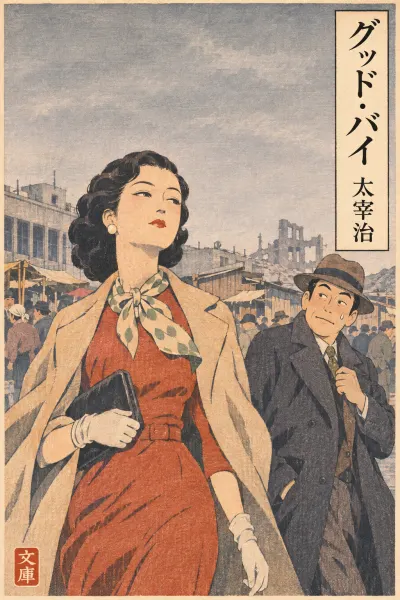
それが、いきなり、すごい美人を連れて、彼女のお店にあらわれる。And now, out of the blue, he turns up at her shop with a knockout beauty in tow.
「こんちは。」というあいさつさえも、よそよそしく、「きょうは女房を連れて来ました。疎開先から、こんど呼び寄せたのです。」Even his "Hello there" sounds distant: "I've brought my wife along today. I've recently sent for her from the place she was evacuated to."
それだけで十分。That was all it took.
青木さんも、目もと涼しく、肌が白くやわらかで、愚かしいところの無いかなりの美人ではあったが、キヌ子と並べると、まるで銀の靴と兵隊靴くらいの差があるように思われた。Ms Aoki was quite a beauty herself, with cool, clear eyes, soft white skin and nothing silly about her. Yet set beside Kinuko, the gap between them seemed like the gap between a silver slipper and an army boot.
二人の美人は、無言で挨拶を交した。The two beauties exchanged greetings without a word.
青木さんは、既に卑屈な泣きべそみたいな顔になっている。Ms Aoki's face had already crumpled into a meek, about-to-cry look.
もはや、勝敗の数は明かであった。The outcome of the contest was already plain.
前にも言ったように、田島は女に対して律儀な一面も持っていて、いまだ女に、自分が独身だなどとウソをついた事が無い。As mentioned before, Tajima had a scrupulous side when it came to women: he had never once lied to a woman and claimed he was single.
田舎に妻子を疎開させてあるという事は、はじめから皆に打明けてある。He had told every one of them from the start that he had evacuated his wife and child to the countryside.
それが、いよいよ夫の許に帰って来た。And now that wife had finally come back to her husband.
しかも、その奥さんたるや、若くて、高貴で、教養のゆたからしい絶世の美人。What's more, this wife of his was young, refined, evidently highly cultured, and a beauty without equal anywhere.
さすがの青木さんも、泣きべそ以外、てが無かった。Even someone like Ms Aoki had no move left but to look on the verge of tears.
「女房の髪をね、一つ、いじってやって下さい。」と田島は調子に乗り、完全にとどめを刺そうとする。"Would you mind doing something with my wife's hair?" Tajima, getting carried away, goes in for the kill.
「銀座にも、どこにも、あなたほどの腕前のひとは無いってうわさですからね。」"Word is there's nobody in Ginza or anywhere else with your kind of skill, you know."
それは、しかし、あながちお世辞でも無かった。That, however, was not entirely flattery.
事実、すばらしく腕のいい美容師であった。She really was a wonderfully skilled hairdresser.
キヌ子は鏡に向って腰をおろす。Kinuko sits down in front of the mirror.
青木さんは、キヌ子に白い肩掛けを当て、キヌ子の髪をときはじめ、その眼には、涙が、いまにもあふれ出るほど一ぱい。Ms Aoki draped a white cape over Kinuko's shoulders and began combing her hair, her eyes so full of tears they might spill over at any moment.
キヌ子は平然。Kinuko, perfectly calm.
かえって、田島は席をはずした。If anything, it was Tajima who stepped away.
Vocabulary
| Word | Meaning | JLPT |
|---|---|---|
| 落ち合せおちあう | to meet up (at an agreed place)dictionary form: 落ち合うOlder spelling; modern texts usually write 落ち合わせ. | — |
| 別離べつり | parting, separationFormal, literary word; everyday Japanese would use 別れ. | — |
| 行進こうしん | march, paradeKey word of the story: the 'goodbye parade' to each lover. | N1 |
| 未亡人みぼうじん | widow戦争未亡人 means a woman whose husband died in the war. | — |
| 公認こうにん | official or open acknowledgementHere it means the relationship is accepted by everyone, not officially registered. | N1 |
| あか抜けたあかぬける | polished, sophisticated, stylishdictionary form: あか抜けるLiterally 'to have the grime washed off'; usually written 垢抜ける. | — |
| 出没しゅつぼつ | appearing and disappearing, frequent visitsOften used of animals or criminals, so it sounds humorous here. | — |
| 卑屈ひくつ | servile, cowed, abject | — |
| 泣きべそなきべそ | a face about to burst into tearsColloquial; 泣きべそをかく means to be on the verge of crying. | — |
| 律儀りちぎ | honest, scrupulous, conscientious | — |
| 絶世ぜっせい | unrivalled in the worldAlmost always appears in the set phrase 絶世の美人, 'a peerless beauty'. | — |
| とどめを刺そうとどめをさす | to deliver the finishing blowdictionary form: とどめを刺すOriginally meant finishing off a fallen enemy with a blade. | — |
| 腕前うでまえ | skill, abilityRelated to 腕がいい, 'skilled'. | N1 |
| 席をはずしたせきをはずす | to step out, leave one's seat or the roomdictionary form: 席をはずす | — |
Grammar
〜せられる N1 is done (old-style passive of する verbs)
せられる is the older literary passive of する, equivalent to modern される. Here 開始せられる means 'is begun', which gives the narration a mock-formal tone.
二人の行進は、日本橋のあるデパート内の美容室に向って開始せられる事になる。
the pair's parade is set to begin, headed for a beauty salon inside a certain department store in Nihonbashi.
〜に違いない N3 must be, is bound to
This pattern expresses a strong conviction. The plain form of the verb comes before it. Here it shows Tajima's confident (and vain) belief that his presence would disturb her business.
やはり彼女の営業を妨げるに違いないと、田島自身が考えているのである。
it was bound to be bad for her business. That, at least, was what Tajima himself thought.
〜てある N4 has been done (and the result remains)
The pattern describes a state that results from a deliberate earlier action. 疎開させてある means the wife and child have been sent away and are still there, and 打明けてある means the fact has already been told.
田舎に妻子を疎開させてあるという事は、はじめから皆に打明けてある。
He had told every one of them from the start that he had evacuated his wife and child to the countryside.
〜たるや N1 as for (emphatic topic)
This is a literary topic marker that adds emphasis or surprise to what follows, stronger than は. Here it sets up the extravagant description of the 'wife'.
しかも、その奥さんたるや、若くて、高貴で、教養のゆたからしい絶世の美人。
What's more, this wife of his was young, refined, evidently highly cultured, and a beauty without equal anywhere.
あながち〜ない N1 not necessarily, not entirely
あながち softens a negative to 'not wholly'. Tajima's praise was meant as a weapon, but it happened to be largely true.
それは、しかし、あながちお世辞でも無かった。
That, however, was not entirely flattery.
いまにも〜ほど N3 so much that it might … at any moment
ほど marks degree, and いまにも adds the sense that the event is about to happen. Together they describe eyes brimming with tears that might spill over any second.
その眼には、涙が、いまにもあふれ出るほど一ぱい。
her eyes so full of tears they might spill over at any moment.