Part 13 of 13 · JLPT N2
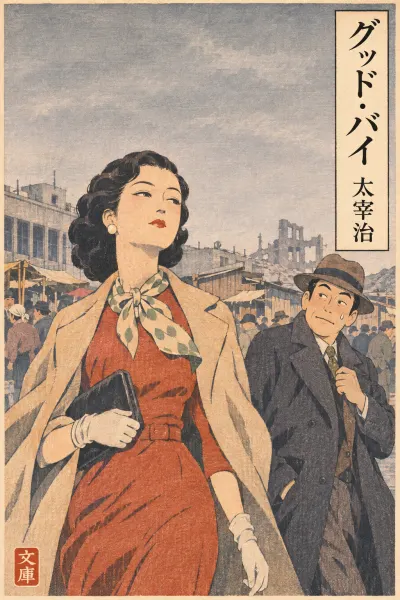
グッド・バイ(コールド・ウォー (二)) Guddobai, part 13: Plan to Use Kinuko as Bodyguard
In this part
Tajima decides to squeeze every bit of use out of Kinuko, even her frightening strength. His next lover to drop is the gentle, tearful painter Mizuhara Keiko, but her burly soldier brother, just back from Siberia, has moved in and answers the phone. Tajima resolves to visit anyway with money, planning to hide behind Kinuko if the brother turns violent, and the story breaks off unfinished.
AI translation · independently checked
こうなったら、とにかく、キヌ子を最大限に利用し活用し、一日五千円を与える他は、パン一かけら、水一ぱいも饗応せず、思い切り酷使しなければ、損だ。Now that things had come to this, he would use Kinuko to the hilt, make the most of her in every way; apart from the five thousand yen a day, he would not treat her to so much as a crust of bread or a glass of water, and he would work her as hard as he possibly could. Anything less would be a loss.
温情は大の禁物、わが身の破滅。Kindness was strictly off-limits. It would be his ruin.
キヌ子に殴られ、ぎゃっという奇妙な悲鳴を挙げても、田島は、しかし、そのキヌ子の怪力を逆に利用する術を発見した。Kinuko had hit him and made him let out a strange yelp of pain, yet Tajima had found a way to turn that very strength of hers to his own advantage.
彼のいわゆる愛人たちの中のひとりに、水原ケイ子という、まだ三十前の、あまり上手でない洋画家がいた。Among his so-called lovers was one named Mizuhara Keiko, a not very skilled painter in the Western style, still under thirty.
田園調布のアパートの二部屋を借りて、一つは居間、一つはアトリエに使っていて、田島は、その水原さんが或る画家の紹介状を持って、「オベリスク」に、さし画でもカットでも何でも描かせてほしいと顔を赤らめ、おどおどしながら申し出たのを可愛く思い、わずかずつ彼女の生計を助けてやる事にしたのである。She rented two rooms in an apartment building in Den'en-chōfu, using one as a living room and the other as a studio. She had come to the Obelisk with a letter of introduction from a certain painter, blushing and timid, and asked to be allowed to draw something for the magazine, illustrations, small sketches, anything at all. Tajima had found her sweet, and decided to help her out with her living expenses, little by little.
物腰がやわらかで、無口で、そうして、ひどい泣き虫の女であった。She was a woman of gentle manners, quiet, and a terrible crybaby.
けれども、吠え狂うような、はしたない泣き方などは決してしない。But she never cried in an unseemly way, howling like a mad thing.
童女のような可憐な泣き方なので、まんざらでない。She cried prettily, like a little girl, so it was not altogether unpleasant.
しかし、たった一つ非常な難点があった。There was, however, just one serious drawback.
彼女には、兄があった。She had an older brother.
永く満洲で軍隊生活をして、小さい時からの乱暴者の由で、骨組もなかなか頑丈の大男らしく、彼は、はじめてその話をケイ子から聞かされた時には、実に、いやあな気持がした。He had spent years in the army in Manchuria, had reportedly been a rough customer since he was a boy, and seemed to be a big man with a very solid frame. When Tajima first heard about him from Keiko, it gave him a truly nasty feeling.
どうも、この、恋人の兄の軍曹とか伍長とかいうものは、ファウストの昔から、色男にとって甚だ不吉な存在だという事になっている。Somehow, ever since the days of Faust, it has been the rule that a sweetheart's brother, the sergeant or the corporal or whatever he is, spells very bad luck for a lady-killer.
その兄が、最近、シベリヤ方面から引揚げて来て、そうして、ケイ子の居間に、頑張っているらしいのである。And now that brother had recently come back from somewhere in Siberia, and it seemed he had planted himself firmly in Keiko's living room.
田島は、その兄と顔を合せるのがイヤなので、ケイ子をどこかへ引っぱり出そうとして、そのアパートに電話をかけたら、いけない、Not wanting to come face to face with the brother, Tajima tried to lure Keiko out somewhere and telephoned the apartment, and—no good:
「自分は、ケイ子の兄でありますが。」"This is Keiko's brother speaking, sir."
という、いかにも力のありそうな男の強い声。It was the strong voice of a man who sounded very powerful indeed.
はたして、いたのだ。Sure enough, he was there.
「雑誌社のものですけど、水原先生に、ちょっと、画の相談、……」"I'm, er, from a magazine. I'd like to talk to Miss Mizuhara for a moment, about a picture..."
語尾が震えている。His voice trembled at the ends of his words.
「ダメです。風邪をひいて寝ています。仕事は、当分ダメでしょう。」"Out of the question. She's got a cold and she's in bed. No work for some time, I should think."
運が悪い。Rotten luck.
ケイ子を引っぱり出す事は、まず不可能らしい。Getting Keiko out of there looked all but impossible.
しかし、ただ兄をこわがって、いつまでもケイ子との別離をためらっているのは、ケイ子に対しても失礼みたいなものだ。Still, to keep putting off the break with Keiko forever just because he was scared of her brother would be, in a way, rather rude to Keiko herself.
それに、ケイ子が風邪で寝ていて、おまけに引揚者の兄が寄宿しているのでは、お金にも、きっと不自由しているだろう。Besides, with Keiko sick in bed and her repatriated brother boarding with her on top of that, she was surely short of money too.
かえって、いまは、チャンスというものかも知れない。If anything, this might be just what you call a chance.
病人に優しい見舞いの言葉をかけ、そうしてお金をそっと差し出す。He would say a few kind, sympathetic words to the invalid, and then quietly slip her some money.
兵隊の兄も、まさか殴りやしないだろう。Surely even her soldier brother wouldn't hit him then.
或いは、ケイ子以上に、感激し握手など求めるかも知れない。He might even be more moved than Keiko and want to shake his hand.
もし万一、自分に乱暴を働くようだったら、……その時こそ、永井キヌ子の怪力のかげに隠れるといい。And if, by any chance, the man looked like getting rough with him... that was exactly when he could hide behind Nagai Kinuko and her monstrous strength.
まさに百パーセントの利用、活用である。This was truly making use of her, getting the most out of her, one hundred percent.
「いいかい? たぶん大丈夫だと思うけどね、そこに乱暴な男がひとりいてね、もしそいつが腕を振り上げたら、君は軽くこう、取りおさえて下さい。なあに、弱いやつらしいんですがね。」All right? I'm sure it'll be fine, you know, but there's a rough sort of fellow there, and if he raises his arm, would you please just, well, hold him down, gently, like this? Oh, I hear he's actually quite a weakling, you see.
彼は、めっきりキヌ子に、ていねいな言葉でものを言うようになっていた。He had come to speak to Kinuko in noticeably polite language.
(未完)(Unfinished)
Vocabulary
| Word | Meaning | JLPT |
|---|---|---|
| 酷使こくしする | to work someone mercilessly, to overworkdictionary form: 酷使する酷 means 'cruel' and 使 means 'use'. | — |
| 禁物きんもつ | something to be avoided, a taboo大の禁物 means 'absolutely forbidden'. | N1 |
| 破滅はめつ | ruin, destruction | — |
| 怪力かいりき | superhuman strength怪 means 'weird' or 'monstrous'. | — |
| 術すべ | a way, a means (of doing something)A literary word. The same kanji is read じゅつ in words such as 技術. | — |
| 泣き虫なきむし | crybaby | — |
| はしたないはしたない | unseemly, undignifiedOften used about behaviour thought improper for a woman. | — |
| まんざらでないまんざらでない | not altogether bad; rather pleasingdictionary form: 満更でないOften hints at quiet, unadmitted pleasure. | — |
| 難点なんてん | drawback, weak point | — |
| 不吉ふきつ | ill-omened, unlucky | N1 |
| 頑張ってがんばる | to dig in, to stay put stubbornlydictionary form: 頑張るThis is the older sense of the verb, 'to hold one's ground', not 'to do one's best'. | — |
| 寄宿きしゅくする | to lodge or board with someonedictionary form: 寄宿する | — |
| 見舞いみまい | a visit or words of sympathy to a sick personお見舞い is the usual polite form. | N3 |
| めっきりめっきり | noticeably, markedlyUsed for a clear change that has come about over time. | N2 |
Grammar
〜の由で N1 reportedly; I hear that
由 marks information heard from someone else. Here it signals that the brother's violent nature is only what Keiko has told Tajima.
小さい時からの乱暴者の由で
reportedly a rough customer since he was a boy
〜という事になっている N3 it is the rule / it is held that
This pattern presents something as an established convention or accepted rule. The narrator uses it ironically, treating a literary cliché as if it were law.
色男にとって甚だ不吉な存在だという事になっている
it has been the rule that he spells very bad luck for a lady-killer
まさか〜やしないだろう N2 surely (someone) won't...
やしない is an emphatic colloquial negative, made from the masu-stem plus や plus しない. Combined with まさか, it expresses confident disbelief that something will happen.
兵隊の兄も、まさか殴りやしないだろう。
Surely even her soldier brother wouldn't hit him then.
その時こそ N3 that is exactly when
こそ puts strong emphasis on the word before it. Here it singles out that moment as the very time to hide behind Kinuko.
その時こそ、永井キヌ子の怪力のかげに隠れるといい。
that was exactly when he could hide behind Nagai Kinuko's monstrous strength.
〜ようになっていた N4 had come to (do something)
〜ようになる: to come to (do something), describing a change in habit or behaviour. In 〜ようになっていた, 〜ている marks a resulting state rather than an ongoing action. The change had already happened by that point, so speaking politely to Kinuko had become Tajima's normal way of talking.
彼は、めっきりキヌ子に、ていねいな言葉でものを言うようになっていた。
He had come to speak to Kinuko in noticeably polite language.