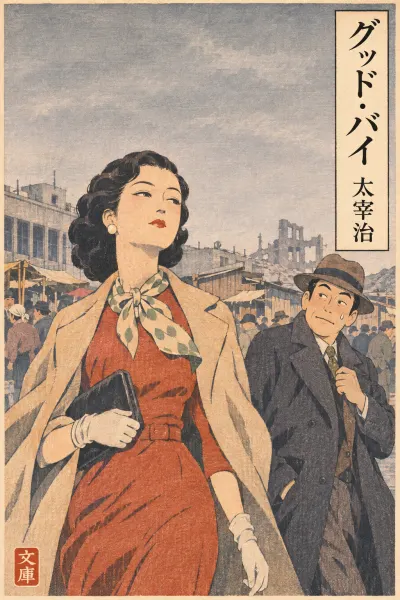
Part 1 of 13 · JLPT N2
グッド・バイ(変心 (一)) Guddobai, part 1: An Editor Resolves to Quit Everything
In this part
Walking home from an elderly literary master's funeral under a shared umbrella, a crude, aging writer teases a handsome young editor about women, and the editor says he means to give them all up. The narrator then explains that this editor, Tajima Shūji, has grown rich on the black market and keeps nearly ten mistresses despite being married, yet has truly begun to long for a settled family life. His first and hardest hurdle is breaking up with all those women smoothly.
AI translation · independently checked
文壇の、或る老大家が亡くなって、その告別式の終り頃から、雨が降りはじめた。A certain grand old man of the literary world had died, and toward the end of his funeral it began to rain.
早春の雨である。It was an early-spring rain.
その帰り、二人の男が相合傘で歩いている。On the way back, two men are walking together under one umbrella.
いずれも、その逝去した老大家には、お義理一ぺん、話題は、女に就いての、極めて不きんしんな事。Both had come to the late old master's funeral purely out of perfunctory duty, and their topic was women, a most improper subject for the occasion.
紋服の初老の大男は、文士。The big, ageing man in a crested kimono is a writer.
それよりずっと若いロイド眼鏡、縞ズボンの好男子は、編集者。The handsome fellow, much younger, in horn-rimmed glasses and striped trousers, is an editor.
「あいつも、」と文士は言う。"He was another one," says the writer.
「女が好きだったらしいな。お前も、そろそろ年貢のおさめ時じゃねえのか。やつれたぜ。」"Liked his women, from what I hear. And you, ain't it about time you paid the piper? You're looking worn out."
「全部、やめるつもりでいるんです。」"I'm planning to quit the whole lot."
その編集者は、顔を赤くして答える。The editor answers, turning red.
この文士、ひどく露骨で、下品な口をきくので、その好男子の編集者はかねがね敬遠していたのだが、きょうは自身に傘の用意が無かったので、仕方なく、文士の蛇の目傘にいれてもらい、かくは油をしぼられる結果となった。This writer talked so bluntly and so crudely that the handsome editor had long kept his distance, but today he had not brought an umbrella, so he had no choice but to let himself be taken in under the writer's bull's-eye umbrella, and this was how he ended up getting such a grilling.
全部、やめるつもりでいるんです。I'm planning to quit the whole lot.
しかし、それは、まんざら嘘で無かった。Yet that was not altogether a lie.
何かしら、変って来ていたのである。Something or other had been changing.
終戦以来、三年経って、どこやら、変った。Three years had passed since the end of the war, and somehow something in him had changed.
三十四歳、雑誌「オベリスク」編集長、田島周二、言葉に少し関西なまりがあるようだが、自身の出生に就いては、ほとんど語らぬ。Thirty-four years old, editor-in-chief of the magazine Obelisk, Tajima Shūji; there seems to be a slight Kansai accent in his speech, but he says almost nothing about where he was born.
もともと、抜け目の無い男で、「オベリスク」の編集は世間へのお体裁、実は闇商売のお手伝いして、いつも、しこたま、もうけている。He had always been a shrewd man: editing Obelisk was a front for the world's benefit, while in fact he helped out in black-market dealings and was always raking in money hand over fist.
けれども、悪銭身につかぬ例えのとおり、酒はそれこそ、浴びるほど飲み、愛人を十人ちかく養っているという噂。But, just as the saying goes that ill-gotten money never stays with you, he drank, truly, as if bathing in liquor, and rumour had it he was keeping close to ten mistresses.
かれは、しかし、独身では無い。He was not, however, a single man.
独身どころか、いまの細君は後妻である。Far from being single, his present wife was in fact his second.
先妻は、白痴の女児ひとりを残して、肺炎で死に、それから彼は、東京の家を売り、埼玉県の友人の家に疎開し、疎開中に、いまの細君をものにして結婚した。His first wife died of pneumonia, leaving behind one mentally disabled little girl; after that he sold his house in Tokyo, evacuated to a friend's home in Saitama Prefecture, and while there he won over his present wife and married her.
細君のほうは、もちろん初婚で、その実家は、かなり内福の農家である。For the wife, of course, it was her first marriage, and her family were farmers who were quietly rather well off.
終戦になり、細君と女児を、細君のその実家にあずけ、かれは単身、東京に乗り込み、郊外のアパートの一部屋を借り、そこはもうただ、寝るだけのところ、抜け目なく四方八方を飛び歩いて、しこたま、もうけた。When the war ended, he left his wife and daughter with her family and charged into Tokyo on his own, renting one room of an apartment in the suburbs, a place simply for sleeping, and, shrewdly darting about in every direction, he raked in a fortune.
けれども、それから三年経ち、何だか気持が変って来た。But then three years went by, and somehow his feelings began to change.
世の中が、何かしら微妙に変って来たせいか、または、彼のからだが、日頃の不節制のために最近めっきり痩せ細って来たせいか、いや、いや、単に「とし」のせいか、色即是空、酒もつまらぬ、小さい家を一軒買い、田舎から女房子供を呼び寄せて、……という里心に似たものが、ふいと胸をかすめて通る事が多くなった。Perhaps because the world had been changing in some subtle way, or because his body had lately grown noticeably thinner from his habitual excesses, or no, no, perhaps simply because of his "age" — form is emptiness, even drinking is dull, I'll buy a little house and bring the wife and child up from the country and... — something like homesickness came more and more often, brushing suddenly across his heart.
もう、この辺で、闇商売からも足を洗い、雑誌の編集に専念しよう。Right, this is the point to wash my hands of the black market too, and devote myself to editing the magazine.
それに就いて、……。As for that...
それに就いて、さし当っての難関。As for that, there was an immediate obstacle.
まず、女たちと上手に別れなければならぬ。First of all, he had to break things off with the women smoothly.
思いがそこに到ると、さすが、抜け目の無い彼も、途方にくれて、溜息が出るのだ。Whenever his thoughts reached that point, even he, shrewd as he was, found himself at a loss and let out a sigh.
「全部、やめるつもり、……」大男の文士は口をゆがめて苦笑し、「それは結構だが、いったい、お前には、女が幾人あるんだい?」"Planning to quit the whole lot..." The big writer twisted his mouth into a wry grin. "Well, that's just fine, but how many women have you got, anyhow?"
Vocabulary
| Word | Meaning | JLPT |
|---|---|---|
| 告別式こくべつしき | funeral service, farewell ceremonyLiterally 'ceremony of saying farewell'. | — |
| 相合傘あいあいがさ | two people sharing one umbrellaUsually suggests a romantic couple, which makes its use for two men comic. | — |
| お義理ぎり | social obligation, dutydictionary form: 義理お義理一ぺん: purely out of duty, nothing more. | N1 |
| 年貢のおさめ時ねんぐのおさめどき | time to settle accounts; time to give up one's bad waysdictionary form: 年貢の納め時Literally 'time to pay the annual land tax'. | — |
| 敬遠けいえんする | to keep at a respectful distance, to avoiddictionary form: 敬遠するPolite on the surface but means avoiding someone. | — |
| 油をしぼられるあぶらをしぼる | (passive) to be given a grilling, to be scolded or teased harddictionary form: 油を絞るLiterally 'to have the oil squeezed out of one'. | — |
| まんざらまんざら | (with a negative) not entirely, not altogetherdictionary form: 満更まんざら〜ない: not wholly ~. | — |
| 抜け目ぬけめ | lapse, oversight; (抜け目の無い) shrewd, sharp, never missing a chance抜け目の無い: shrewd, never missing a chance. | — |
| しこたましこたま | loads, a great deal (of money)Colloquial; often with もうける or 飲む. | — |
| 悪銭身につかぬあくせんみにつかず | proverb: ill-gotten money never stays with youdictionary form: 悪銭身につかずつかぬ is the old negative form of つかない. | — |
| 細君さいくん | wife (one's own or another's)Old-fashioned, slightly humorous word. | — |
| 疎開そかいする | to evacuate (from cities during the war)dictionary form: 疎開する | — |
| 足を洗いあしをあらう | to wash one's hands of, to quit (a shady business)dictionary form: 足を洗う | — |
| 途方にくれてとほうにくれる | to be at a loss, not know what to dodictionary form: 途方に暮れる | — |
Grammar
〜つもりでいる N3 to be intending to ~
Adding でいる to つもり stresses that the intention is a settled state of mind the speaker currently holds, rather than a passing plan.
全部、やめるつもりでいるんです。
I'm planning to quit the whole lot.
〜てもらう N4 to have someone do something for one
いれてもらい means the editor received the favour of being let under the umbrella. The pattern shows who benefits from the action.
文士の蛇の目傘にいれてもらい
letting himself be taken in under the writer's bull's-eye umbrella
〜どころか N2 far from ~; not only not ~ but
It rejects the first idea and replaces it with something going further in the opposite direction: not single at all, and in fact on his second marriage.
独身どころか、いまの細君は後妻である。
Far from being single, his present wife was in fact his second.
〜せいか N3 perhaps because of ~
せい marks a cause, usually an unwelcome one, and か makes it uncertain. Repeating it lists several possible reasons.
単に「とし」のせいか
perhaps simply because of his "age"
〜なければならぬ N4 must ~
This is なければならない with the literary negative ぬ in place of ない. It gives the narration a stiff, slightly old-fashioned tone.
まず、女たちと上手に別れなければならぬ。
First of all, he had to break things off with the women smoothly.